Website of the Gods!!!

This is a blog of the gods, Ancient Rome, the Gallic Wars, translations, and other Latiny stuff!

Tuesday, September 14, 2010

Horace 1.11-Formal Analysis and Structural Analysis


Horace 1.11:
Tu ne quaesieris (scire nefas) quem mihi, quem tibi
finem di dederint, Leuconoe, nec Babylonios
temptaris numeros. Vt melius quicquid erit pati!
Seu pluris hiemes seu tribuit Iuppiter ultimam,
quae nunc oppositis debilitat pumicibus mare
Tyrrhenum, sapias, uina liques et spatio breui
spem longam reseces. Dum loquimur, fugerit inuida
aetas: carpe diem, quam minimum credula postero.

Parsed Verbs:
Scire-present active infinitive meaning "to know"
Dederint-3rd person plural future perfect active indicative of "dare" meaning "to give"
Erit-3rd person singular future active indicative of "esse" meaning "to be"
Pati-present active infinitive meaning "to suffer"
Tribuit-3rd person singular present active indicative of "tribuere" meaning "to assign"
Debilitat-3rd person singular present active indicative of "debilitare" meaning "to weaken"
Sapias-2nd person singular present active subjunctive of "sapere" meaning "to have sense"
Reseces-2nd person singular present active subjunctive of "resecare" meaning "to cut back"
Fugerit-3rd person singular future perfect active indicative of "fugere" meaning "to flee"
Carpe-2nd person singular present active imperative of "carpere"  meaning "to seize"

Translation:
Don't you keep searching, to know is a sin, what to me, what to you
Goals that the gods will have given, Leuconoe, do not test the Babylonian
numbers. To suffer whatever is noble!
Whether Jupiter assigned the farthest winters or many,
Which now weakens against the pumice of the
Tyrrhenian sea. May you have sense, strain the wine and check your long hopes
In this small space. As we are speaking, jealous time
flies: Seize the day, with little confidence in the next.

Formal Analysis:
The poem's title is Horace 1.11
The theme is so down and take life one day at a time, using the youth of life to the fullest.
The narrator aims at spring time as the setting.
The narrator is Horace, and the poem invites us to equate the author with the narrator.
The poem has an internal addressee, named Leuconoe (line 2)
The characters in the poem are Horace, Leuconoe, and Jupiter (Line 4). Horace reports on Leuconoe, but Jupiter acts in his own right.
The poem has a mood of taking life by the reigns.
Horace is attracted to Leuconoe, and wanted to woo her, so set the poem in motion. The poem anticipates that Leuconoe will seize the day and take Horace up on his offer.
The poem alludes to Jupiter, the king of the gods, and his role in the world. It also alludes to the Babylonian numbers, which are part of an old, complicated number system.

Structural Analysis:
Horace speaks to Leuconoe on living life one day at a time, and embracing it. Horace basically says, "Stop paying attention to everything else, we're what's important. Whether you'll have a long life or short life, time's running out. We're ready, let's go. This is the springtime of our lives, let's start having fun. Stop hoping for a bright future, live in the moment. We are in our youth, and time itself is jealous of us. So seize the day, trusting the future as little as possible."
The spacing in the poem shows specific placement in words likes Babylon, Jupiter, and Tyrrhenian. Placement in Latin is very free and can be used to convey specific meaning. The lines are all also around 15 syllables long. Also, none of any of the sentences ever start with a verb.
Starting out the poem with "Tu" shows that the poem is like a letter addressed to someone. Also, starting out with a verb like "quaesieris" (Line 1) gives the impression that the whole poem will be about seeking, striving, and obtaining. Ending the poem with "little confidence in the next" shows that the now is what is important in the poem.
Jupiter is a symbol of power, as he is the "hinge" that the world relies on as the ruler of the gods. He is a symbol of action in the present, not past or future, as his job demands.
The allusion to the Babylon numbers and number system shows that one need not go against the current and fight what is already established, as it is not important or something big to worry about. Now is not the time to be profound, but to act in the moment. There is also an allusion to the Tyrrhenian Sea. People must live their lives to the fullest before they are eroded like water does to stone.
Horace chose to keep things succinct and to the point, with not many superfluous words or adjectives. He chose keep his point short and sweet, like each day that should be lived by one like Leuconoe.

Wednesday, September 8, 2010

"The Second Coming"-A Formal Analysis

The title of the poem is "The Second Coming,” by W.B. Yeats. The themes are those of revelation, destruction, and the apocalypse. The setting of this poem is the Earth. The poem states no time, but while it was being written, Yeats thought that the world was on the threshold of an apocalyptic moment. The narrator is implicit and is third person omniscient in the first stanza, and is first person in the second stanza. It is a single person. The poem seems to equate the narrator and the author in the second stanza. The implied reader is the assumed audience. The characters in the poem include the falcon, the falconer, the best, the worst, a shape with a lion body and the head of a man, desert birds, a rough beast, and the narrator. All the characters have no agency, excluding the narrator, who is the only character to speak and act in their own right. Otherwise, the characters are just reported on. The mood of the poem is somber and serious throughout the poem. The poem describes the whole world. The world has been rotting before the poem started, and seems about to end. A question ends the poem, asking whether or not the world will be saved or left to destroy itself. The ending seems to anticipate that the world will be saved. The poem holds many allusions. The gyre in line 1 refers to another of Yeats’ poems, in which two cones make up history, and an apocalyptic moment occurs, as history switches cones. Lines 7 and 8 are a paraphrase of Prometheus Unbound, a book which Yeats regarded with religious awe. The revelation and Second Coming cited in the poem allude to the Book of Revelations in the New Testament of the Bible and the Second Coming of Christ, respectively. The Spiritus Mundi refers to a belief of Yeats’ that each human mind is linked to a single vast intelligence. The shape with a lion body and the head of a man referred to the sphinx, who guards the gates of Thebes. The rough beast slouching to Bethlehem to be born is Christ, and gives hope at the end of the poem. All of these allusions reinforce the explicit meaning, except the allusion to Jesus. This final allusion subverts the explicit meaning, giving hope that perhaps the world will not fall into oblivion.

Tuesday, September 7, 2010

Ki-A Structural Analysis


"Ki" is a traditional cell animation about a person feeling locked up in his own life. In the video, much of what is stated is done without words. The director portrays a lifeless, depressing world, in which one man is trapped from birth until death.
A circle of onlookers watch as a child is born and presented a key. He uses that key throughout life to unlock the next stages of his life. He matures, marries, gets a job, grows old, and then dies. A circle of onlookers watched as the key was taken away. (Proairetic)
Throughout the video, people fly in and out of a circle, with ki's energy beating in the background. The man is also always in a cage of some sort, never to be free his whole life. (Hermeneutic)
A circle of onlookers surround the man as he is born, and as he dies. This connotates that one leaves life as one enters life. All the cages portray the trapping of the man. (Semic)
The key symbolizes the man's life force and a way to unlock the next stages of his life, until he dies. At that point, he has no use for the key, so it is taken away. (Symbolic)
Ki is Japanese for the life force/energy that permeates the world. In this case, it is manifested physically in the key. (Reference)
The many repeated colors and pattern of life portrays a homogenous, soul-suckingly depressing world. This supports the feeling of being trapped by the world. (Diagetic)
The man feels that the world has stripped him of himself, only leaving him with a superficial shell with which to live the rest of his life. He must conform and be as everyone expects him. It is not a choice. This causes the feeling of being trapped in life, being freed only through death.
[:ki]Google Video. Web. 7 Sept. 2010. <http://video.google.com/videoplay?docid=1001413595702190711#>.
"Qi." Wikipedia, the Free Encyclopedia. Web. 07 Sept. 2010. <http://en.wikipedia.org/wiki/Qi>.

Friday, June 11, 2010

Honors Latin II Final Part 2

Paragraph 1:
Among the Helvetii, Orgetorix was by far the most noble and rich. He, when M. Messala and M. Pisone were consuls, induced by desire of sovereignty, made a conspiracy and persuaded the nobles and citizens to march with him away from their territory with all their supplies: this would be very easy, as they excelled all in bravery, to gain command of the whole of Gaul. He persuaded them that this was easy to do, that from every side the natural location secured them: from one part the Rhine River was broad as well as deep, which divided the territory of the Helvetii from the Germans; from another part was the high Jura Mountain, which is between the Sequani and the Helvetii; from the third part was Lake Lemmano and the river Rhone, which divided our province from the Helvetii. These things made very little space that they could roam in, and they were not enough able to easily bring war to their neighbors; any human from that part was eager to wage war, and this made them sorrowful. While before a great crowd of men, and before the glory as well as valor of war, to have them judge their confined territory, which in length was 240 Roman miles, and they lie open in width of 180 Roman miles.

Paragraph 2:
This Helvetii thing is revealed by a truce. They gathered, as was custom, to talk about the cause to Orgetorix himself in chains; if found guilty, the penalty was to burn in fire. On the agreed day of the occasion for judgment, all of Orgetorix's family gathered for the trial, up to ten thousand people from every side, and all of his clients and debtors, of which he had a great number, drew together in the same place; that through them he did not make his plea, but was snatched away. Together the citizens, for the sake of him, aroused with weapons, to follow in an attempt and crowd of people to force the magistrate out of their territory, but Orgetorix was dead, and neither was suspicion away, as the Helvetii judged, that he did not commit suicide.

Paragraph 3:
After his death, the Helvetii did nothing less than set up to make an attempt anyway, to move out of their territory. Where now they were preparing to be decided on this thing, they set fire to all their towns (which numbered up to 12), they set fire to their 400 villages, and they set fire to the remainder of the private buildings; They burned all the crops that they could not carry between them, and suffered burning their homes so that there was no hope of returning, and they were prepared to endure all dangers; They had ordered for three months of rations to bring out of their homes. They persuaded the Rauracis and Tulingis and Latobrigis, their neighbors, to take the same plan, and, after burning their towns and villages, to set out with them: And they admit to their party and unite with themselves as confederates the Boios, who had lived on the other side of the Rhine, and had crossed over into the Noricum territory, and assaulted Noreia.

Sorry, Mr. Wojo, I butchered the tenses and moods, as I was in a hurry, but the paragraphs seem to make sense.

Honors Latin II Final Part 1

ID and parse verbs and nouns

Paragraph 1:
1. fuit-3rd person singular perfect active indicative of "esse" meaning "to be"
2. dividit-3rd person singular present active indicative of "dividere" meaning "to divide"
3. praestarent-3rd person plural imperfect active subjunctive of "praestare" meaning "to excel"
4. patebant-3rd person plural imperfect active indicative of "patere" meaning "to be open"
5. est-3rd person singular present active indicative of "esse" meaning "to be"
1. civitati-city, dative
2. virtute-bravery, dative
3. loci-location, genitive
4. flumine-river, dative
5. provinciam- province, accusative

Paragraph 2:
1. est-3rd person singular present active indicative of "esse" meaning "to be"
2. habebat-3rd person singular imperfect active indicative of "habere" meaning "to have"
3. coegerunt-3rd person plural perfect active indicative of "cogere" meaning "to gather"
4. cogerent-3rd person plural present active indicative of "cogere" meaning "to gather"
5. conduxit-3rd person singular perfect active indicative of "conducere" meaning "to collect"
1. causam-cause, accusative
2. poenam-penalty, accusative
3. familiam-family, accusative
4. civitas-city, nominative
5. armis-weapon, ablative

Paragraph 3:
1. constituerant-3rd person plural pluperfect active indicative of "constituere" meaning "to set up"
2. comburunt-3rd person plural present active indicative of "comburere" meaning "to burn up"
3. exeant-3rd person plural present active subjunctive of "exire" meaning "to go"
4. erant-3rd person plural imperfect active indicative of "esse" meaning "to be"
5. iubent-3rd person plural present active indicative of "iubere" meaning "to order"
1. rem-thing, accusative
2. numero-number, dative
3. pericula-danger, nominative
4. praeter-besides, accusative
5. frumentum-grain, nominative

Paragraph 4:
1. esset-3rd person singular imperfect active subjunctive of "esse" meaning "to be"
2. potest-3rd person singular present active indicative of "posse" meaning "to be able to"
3. pervenit-3rd person singular present active indicative of "pervenire" meaning "to come to"
4. imperat-3rd person singular present active indicative of "imperare" meaning "to command"
5. erat-3rd person singular imperfect active indicative of "esse" meaning "to be"
1. provinciam-province, accusative
2. urbe-city, dative
3. legatos-ambassador, accusative
4. legationis-embassy, genitive
5. animo-spirit, dative

Paragraph 5:
1. est-3rd person singular present active indicative of "esse" meaning "to be"
2. possit-3rd person singular present active subjunctive of "posse" meaning "to be able to"
3. concidit-3rd person singular present active indicative of "concidere" meaning "to fall"
4. mandarunt-3rd person plural perfect active indicative of "mandare" meaning "to entrust"
5. appellebatur-3rd person singular imperfect passive indicative of "appellere" meaning "to call"
1. oculis-eye, dative
2. partem-part, accusative
3. flumen-river, nominative
4. consulem-consul, accusative
5. memoria-memory, nominative

Thursday, June 3, 2010

Did Caesar want the Gallic Wars to begin?

Yes, Caesar definitely wanted the Gallic Wars to begin. Out of all things, a great military conquest would boost his popularity among the Romans immensely. This would show all the citizens his worthiness, he would have gained new territory, and he would bring back the spoils of war. He knew that this could be his chance to become great, and would help in his quest to rule Rome. If the approval of the majority of the Romans was not important to him, he would not have written the Commentarii de Bello Gallico, which was written to send back to the Romans, to keep them updated on his exploits. Caesar was all for the Gallic Wars.

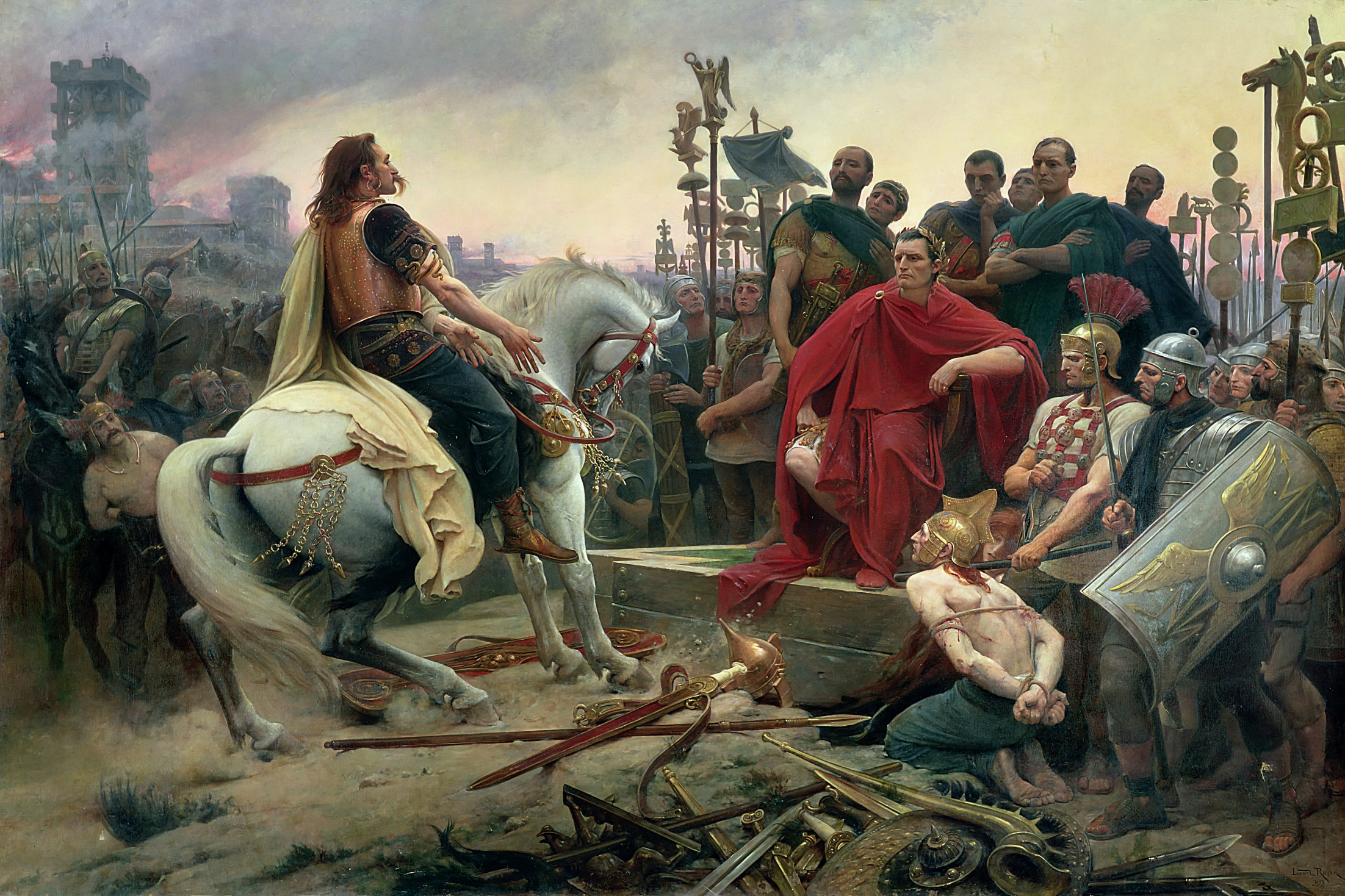
Picture of Vercingetorix is shown.

Statue Vercingetorix Alesia. Digital image. Wikimedia Commons. Web. 3 June 2010. <http://upload.wikimedia.org/wikipedia/commons/4/4f/Statue_Vercingetorix_Alesia.jpg>.

Wednesday, June 2, 2010

Vercingetorix

Vercingetorix was chieftain of the Averni tribe. He united the Gauls in an attempt to revolt against Roman forces during the last phase of the Gallic Wars. This was an unsuccessful attempt. Vercingetorix came to power in 52 BC. He raised an army and was proclaimed king in Gergovia. He established alliances with other tribes and took control of their combined armies. He was defeated in the Battle of Alesia, after which he was imprisoned for five years. In 46 BC he was paraded through Rome as part of Caesar's triumph before being executed.

Siege Alesia Vercingetorix Julius Caesar. Digital image. Wikimedia Commons. Web. 2 June 2010. <http://upload.wikimedia.org/wikipedia/commons/9/93/Siege-alesia-vercingetorix-jules-cesar.jpg>.
"Vercingetorix." Wikipedia, the Free Encyclopedia. Web. 02 June 2010. <http://en.wikipedia.org/wiki/Vercingetorix>.

Tuesday, June 1, 2010

Site Visits!

Now on six continents! Darn Antarcticans!

Friday, May 28, 2010

Synopsis of Asterix

The setting is in a coastal village in Armorica, a province of Gaul in the year 50 BC. Caesar has conquered nearly all of Gaul for the Roman Empire. The single village has held out because of their druid Getafix, who concocts a potion giving temporary superhuman strength. Asterix, because of his brains, is usually given the important tasks of the village. He is aided by his fat and dumb friend Obelix, who fell into a vat of the potion as a child, and has permanent superhuman strength. They are accompanied by Dogmatix, Obelix's dog.

Asterix. Digital image. Asterix.co. Web. 28 May 2010. <http://www.asterix.co.nz/characters/gauls/asterix.jpg>.
"Asterix." Wikipedia, the Free Encyclopedia. Web. 27 May 2010. <http://en.wikipedia.org/wiki/Asterix>.

Thursday, May 27, 2010

The Adventures of Asterix

The Adventures of Asterix is a French comic book series written by Rene Goscinny and illustrated by Albert Uderzo. Uderzo also took over writing the series after Goscinny's death in 1977. The comic first appeared in the French magazine Pilote October 1959. As of 2009, 34 comic books have been released. This is one of the most popular Franco-Belgian comics in the world. The books lead to movies, games, and even a theme park near Paris (Parc Asterix).
The comic follows a village in ancient Gaul as they resist Roman occupation. The village druid supplies a potion which gives the recipient superhuman strength. This is how they resist the Romans. Asterix and his friend Obelix have many adventures that take place in Gaul and around the world.

 "Asterix." Wikipedia, the Free Encyclopedia. Web. 27 May 2010. <http://en.wikipedia.org/wiki/Asterix>.
Asterix-Cast. Digital image. Wikimedia Commons. Web. 27 May 2010. <http://upload.wikimedia.org/wikipedia/en/f/f0/Asterix_-_Cast.png>.

Wednesday, May 26, 2010

Julius Caesar's Family Tree

Caesar's parents were Gauis Julius Caesar the Elder and Aurelia Cotta. His sister was Julia Caesaris. Caesar had three wives. These were (1) Cornelia Cina minor, (2) Pompeia, and (3) Calpurnia Pisonis. Caesar had one child with Cornelia. She was Julia Caesaris, who later married Pompey. Caesar still needed a successor to his throne. He then adopted Gauis Juliua Caesar Octavianus Augustus.

"Julio-Claudian Family Tree." Wikipedia, the Free Encyclopedia. Web. 26 May 2010. http://en.wikipedia.org/wiki/Julio-Claudian_family_tree.
Caesar Family Tree. Digital image. The-Romans. Web. 26 May 2010. http://www.the-romans.co.uk/images/caesar_tree.jpg.

Tuesday, May 25, 2010

Deployment Commands


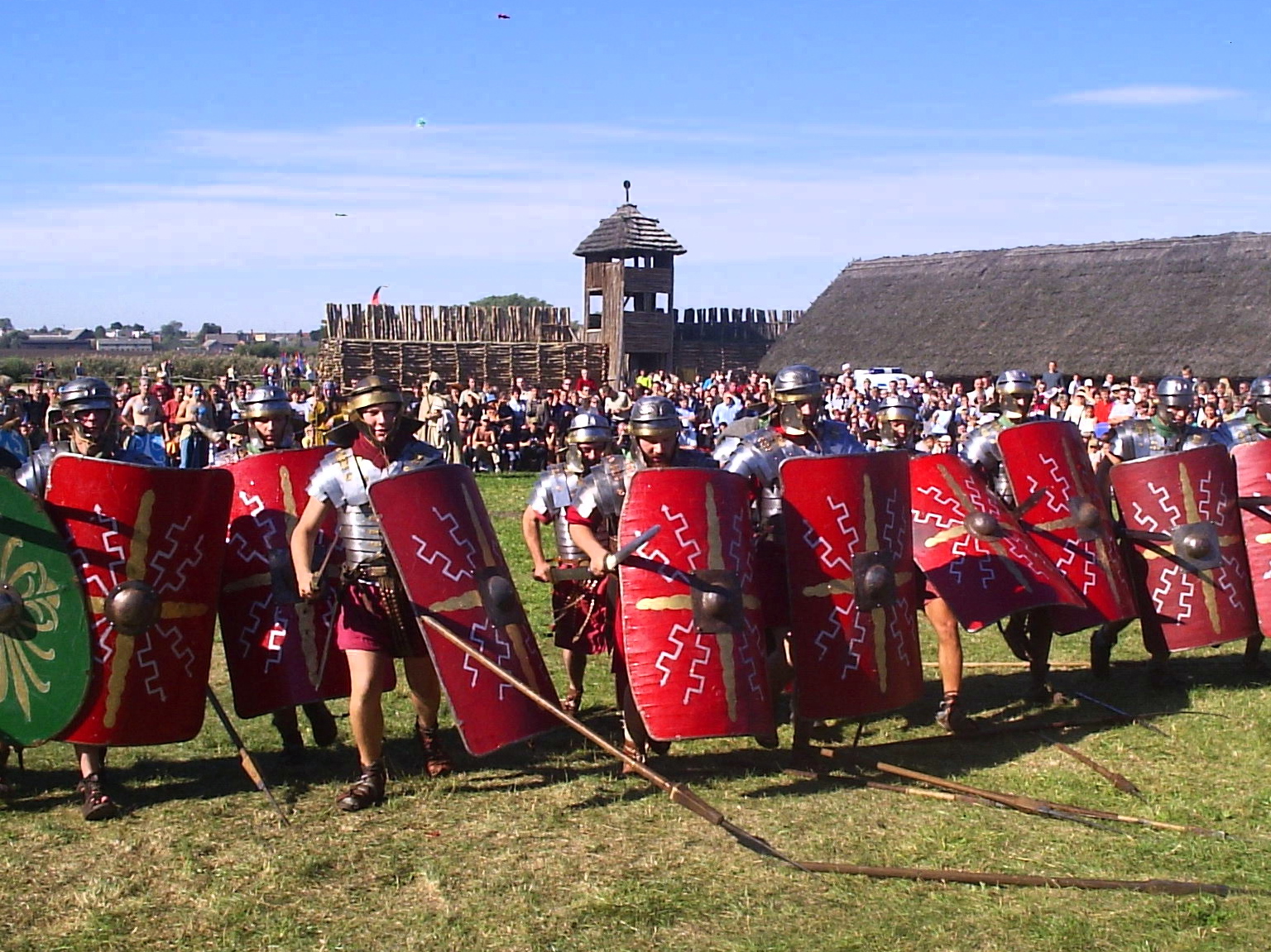
The Roman army was marked by flexibility, discipline, and cohesion. Different formations were assumed according to different tactical situations.

~Repellere equites-to repel cavalry
~Eicere pila-to hurl the pila
~Cuneum formate-the wedge formation
~Contendite vestra sponte-the legionaries formed an agressive stance and attacked every opponent they faced.
~Orbem formate-the orb formation
~Ciringite frontem-hold your position
~Frontem allargate-scattered formation
~Testudinem formate-the turtle formation
~Agmen formate-the square formation

"Roman Infantry Tactics." Wikipedia, the Free Encyclopedia. Web. 25 May 2010. http://en.wikipedia.org/wiki/Roman_infantry_tactics.
The Orb. Digital image. Roman-Empire. Web. 25 May 2010. http://www.roman-empire.net/army/orb.html.

Thursday, May 20, 2010

Teachers would help me learn better if they…

  • Would do something more interactive in class
  • Would bring something entertaining to keep my attention
  • Wouldn't just talk at the students, but to the students
  • Wouldn't just force students to take notes as the entire class
  • Would actually teach the subject material, not just give random pointless assignments in class to keep students busy
  • Wouldn't have things show up on the test that they didn't teach
  • Wouldn't teach superfluous things that won't show up on tests, as they detract from learning the important material
  • Would stop for a second to make sure each individual understands the material
  • Would repeat important topics
  • Would do hands on projects, as hands on is fun and interactive
  • Would be approachable for extra help

Wednesday, May 19, 2010

Wednesday, May 12, 2010

Gallic Wars-Paragraph #7

It was announced to Caesar that they were attempting to make their journey through our province, he hurried to depart from the city and which was able to be the greatest and farthest journey that reached in Gaul and he arrives in Geneva. He orders the whole Province with as great a number of soldiers as possible, as there was in all only one legion in farther in Gaul: he orders the bridge at Geneva to be broken down. When the Helvetii are alerted of his arrival they send to him, as ambassadors, the most illustrious men of their state, in which embassies Numeius and Verudoctius held the chief place, to say "that it was their intention to march through the Province without doing any harm, because they had" according to their own representations, "no other route: that they requested, they might be allowed to do so with his consent." Caesar, because he kept in remembrance that Lucius Cassius, the consul, had been slain, and his army routed and made to pass under the yoke by the Helvetii, did not think that ought to be granted: nor did he think that men of hostile disposition, if an opportunity of marching through the Province were given them, would abstain from outrage and mischief. Yet, in order that a period might intervene, until the soldiers whom he had ordered should assemble, he replied to the ambassadors, that he would take time to deliberate; if they wanted any thing, they might return on the day before the ides of April.

Wednesday, May 5, 2010

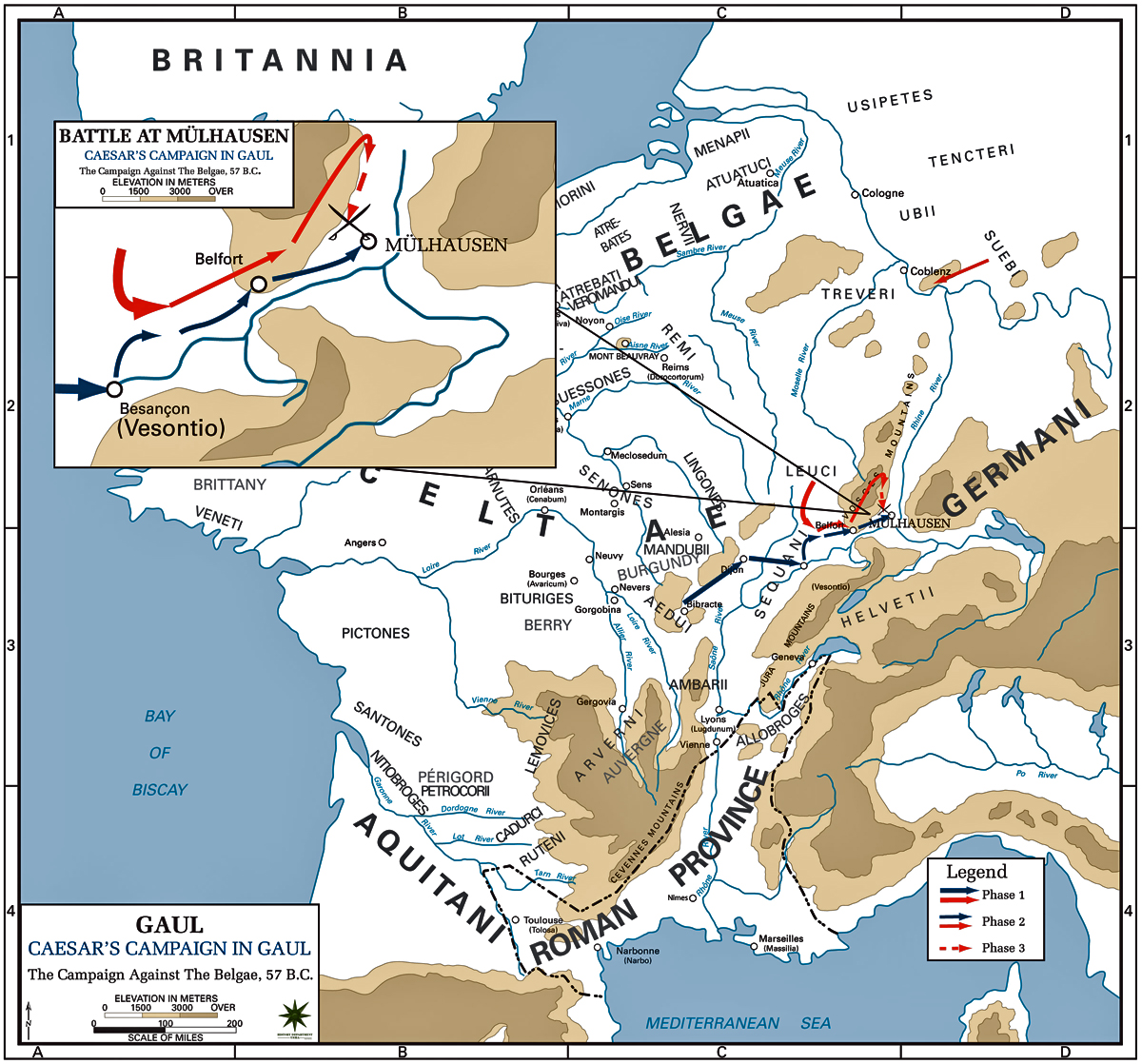
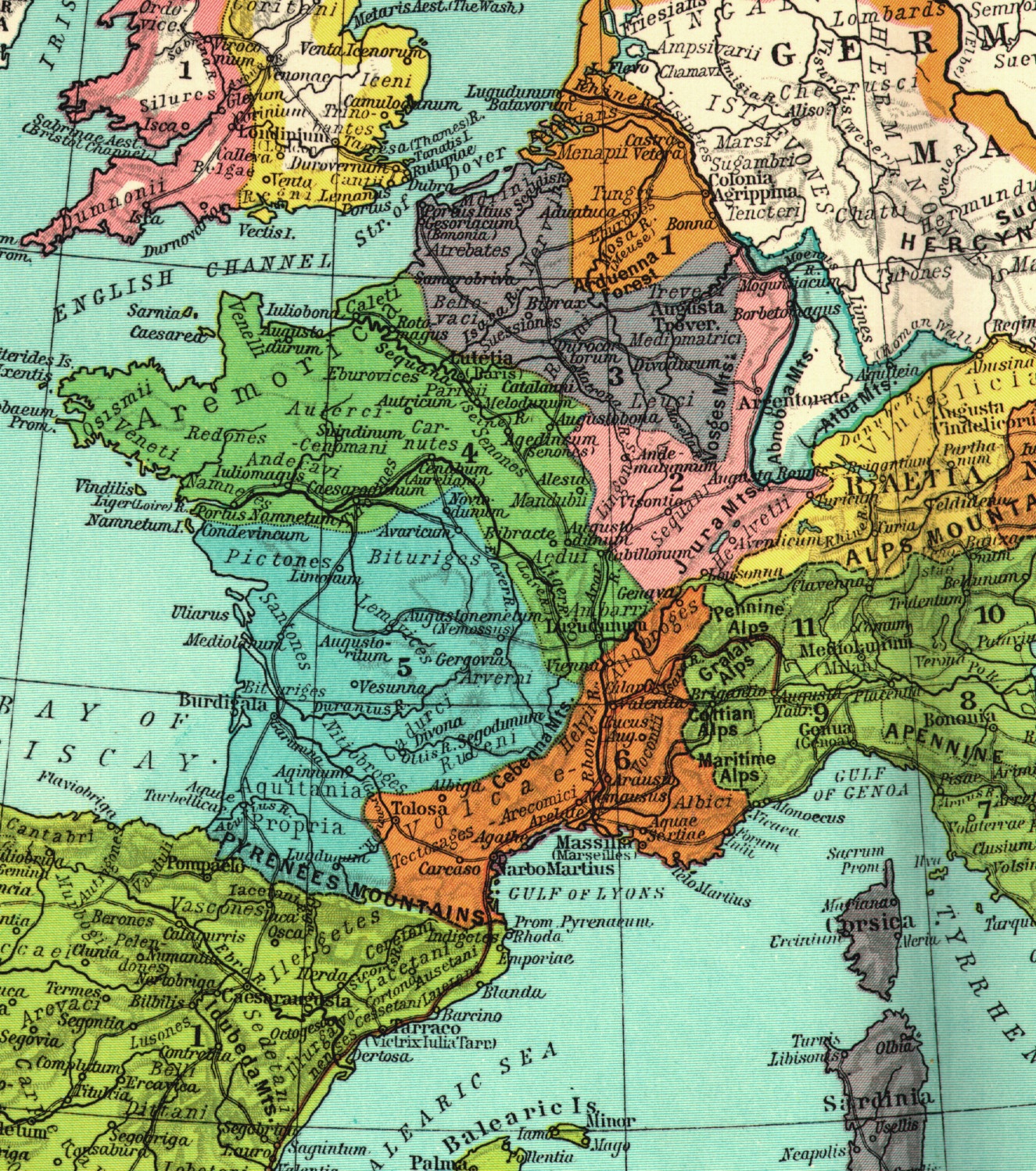
Maps of Gaul!

Gaul is present-day France, Luxembourg, and Belgium.

Works Cited
Caesar's Campaign in Gaul. Digital image. Emersonkent. Web. 5 May 2010. <http://www.emersonkent.com/images/caesars_gaul.jpg>.
Celtic Tribes. Digital image. CeltNet. Web. 5 May 2010. <http://www.celtnet.org.uk/images/gaul_large.gif>.
Colored map of Gaul. Digital image. Pitt. Web. 5 May 2010. <http://www.pitt.edu/~medart/image/france/france-l-to-z/mapsfrance/sf038fra.jpg>.
Cultural Areas in Gaul. Digital image. Athena Pub. Web. 5 May 2010. <http://www.athenapub.com/gaul3prz.GIF>.
Gaul 1st Century BC. Digital image. Wikimedia Commons. Web. 5 May 2010. <http://upload.wikimedia.org/wikipedia/commons/c/ca/Gaul%2C_1st_century_BC.gif>.
Map Gallia Tribes Towns. Digital image. Wikimedia Commons. Web. 5 May 2010. <http://upload.wikimedia.org/wikipedia/commons/b/ba/Map_Gallia_Tribes_Towns.png>.

Tuesday, May 4, 2010

Discipline in the Roman Legion

Discipline was quite harsh, and rules were strictly enforced in the Roman Legion

Minor punishments-being hit by the centurion with a staff (castigatio), reduction of rations, reduction in pay (pecuniaria multa), flogging  in front of the legion, whipping with the flagrum (short whip), reduction in rank (gradus deiectio), dishonorable discharge (missio ignominiosa), loss of time in service advantages, relegation to inferior duties (militiae mutatio), additional duties (munerum indictio)

Major punishments
-Fustuarium-a sentence for desertion or dereliction of duty. The legionary would be stoned or beaten to death with cudgels in front of the army
-Decimation-this was carried out against an entire mutinous unit. One out of every ten men, chosen by lots, would be beaten to death by the other nine men.

"Roman Legion." Wikipedia, the Free Encyclopedia. Web. 4 May 2010. .
Roman Legion at Attack 10. Digital image. Wikimedia Commons. Web. 4 May 2010. .

Monday, May 3, 2010

Parsing Check-Gallic Wars paragraphs 3 + 4

Pick 10 verbs:
1. comparare-present active infinitive meaning "to prepare"
2. coemere-present active infinitive meaning "to buy"
3. facere-present active infinitive meaning "to make"
4. confirmare-present active infinitive meaning "to strenghten"
5. esse-present active infinitive meaning "to be"
6. confirmant-3rd person plural present active indicative of "confirmare" meaning "to strengthen"
7. sperant-3rd person plural present active indicative of "sperare" meaning "to hope"
8. est-3rd person singular present active indicative of "esse" meaning "to be"
9. dicere-present active infinitive meaning "to speak"
10. habebat-3rd person singular imperfect active indicative of "habere" meaning "to have"