Sunday, October 19, 2008
The Curse of Atreus
Atreus and Thyeste are the sons of Pelopis. Thyestes seduces Atreus's wife; at the time, he was not able to truly tolerate the discovery. Plot, therefore, against a brother, he thought; "You are abundantly angry. Becuase of you my few sons cut up and killed their brother. Then I ought to cook he and Thyestes for dinner. He killed the boys; Thyestes saw his own dead boys on the table. Oh, unfortunate Thyestes! He did not have anything. But, Oh Atreus, becuase of your great and true sons you ought to have great penalty. In our evil sons remains your ancient blame; it was perpetual. You ought to think of an ambush, oh Atreus? Your anger is not able to overcome; evil, therefore, is always your reputation. You are turly praised, but have many faults.

Friday, October 17, 2008
Chapter 6 Paradigm Test
1. Sum Present Act. Ind.
sum-to be
sum
es
estis
sumus
e
sunt
2. Sum Imperfect Active Ind.
sum-to be
ero
eris
erit
erimus
eritis
erunt
3. Sum Future Act. Ind.
sum-to be
eram
eras
erat
eramus
eratis
erant
1. Possum Present Act. Ind.
possum- to be able
Possum
potes
potest
possumus
potestis
possunt
2. Possum Imperfect Active Indicative
possum-to be able
Potero
poteris
poterit
poterimus
poterunt
3. Possum Future Act. Ind.
possum-to be ablhe
poteram
poteras
poterat
poteramus
poteratis
poterant
sum-to be
sum
es
estis
sumus
e
sunt
2. Sum Imperfect Active Ind.
sum-to be
ero
eris
erit
erimus
eritis
erunt
3. Sum Future Act. Ind.
sum-to be
eram
eras
erat
eramus
eratis
erant
1. Possum Present Act. Ind.
possum- to be able
Possum
potes
potest
possumus
potestis
possunt
2. Possum Imperfect Active Indicative
possum-to be able
Potero
poteris
poterit
poterimus
poterunt
3. Possum Future Act. Ind.
possum-to be ablhe
poteram
poteras
poterat
poteramus
poteratis
poterant
Thursday, October 16, 2008
Chapter 6 Optional Exercises
#'s 6-24
6. Your country was free.
7. I was able to be a tyrant.
8. Your friend will be a tyrant.
9. Where there is a tyrant, there are men that are not able to be free.
10. He could not remain in our contry yesterday.
11. Tyrants will always have many faults.
12. We were not able to overcome the tyrants.
13. We ought to overcome our tyrant.
14. The tyrant was able to overcome good men; but he willl not be able to remain there.
15. You will be able to see the dangers of a tyrant.
16. We cannot tolerate the fualts of tyrants.
17. You were not tolerating the treachery of the tyrant.
18. The pleasure in your fatherland cannot be perpetual.
19. You ought to warn free men about tyrants.
20. Your teacher schoolmaster always used to like fine books.
21. Good and true books were able to save the country.
22. You willl be able to preserve your country with good books.
23. Tyrants will not be able to be above the wisdom of good books.
24. Bad men cannot tolerate good books.
Chapter 6 Vocab
1. dea-goddess
2. discipula-student
3. insidiae-ambush
4. liber-book
5. tyrannus-tyrant
6. vitium-crime
7. Graecus- Greek
8. perpetuus-perpetual
9. plenus-abundant
10. salvus-safe
Bonus;
1. secundus-second
2. possum-to be able
2. discipula-student
3. insidiae-ambush
4. liber-book
5. tyrannus-tyrant
6. vitium-crime
7. Graecus- Greek
8. perpetuus-perpetual
9. plenus-abundant
10. salvus-safe
Bonus;
1. secundus-second
2. possum-to be able
Friday, October 10, 2008
Roman Gladiators

Gladiator is from the Latin "gladius" which means "sword". Gladiators were professional fighters who battled for the enjoyment of the audience in the ampitheathers they performed in. The Coliseum was the most famous amphitheater that gladiators fought in (see The Coliseum and it's Architecture post). Gladiators were mostly males and were mostly slaves, condemned criminals, prisoners of war, and sometimes Christians. The largest amount of gladiators in one event was 5000 pairs of fighters. They were forced to become swordsmen and trained in schools called ludi. Special measures were taken to prevent them from commiting suicide. A successful gladiator received great acclaim. He was pampered and sometimes portrayed on art. Some gladiators who survived were let free. Occasionally, freedmen and Roman citizens fought, and once the mad Emperor Commodus entered the arena. The classes of fighters were light armored or heavy armored. The retiarius (net man) tried to entangle the fully armed secutor (pursuer) with a net and then kill him with a trident. Other classes fought with different weapons, and sometimes used horses or chariots. According to tradition, when a gladiator overpowered his opponent, he looked to the crowd to decide wether he should live or die. The crowd waved handkercheifs if they wanted the felled gladiator to be spared and turned down their thumbs if they wished for his death. Gladiator matched continued until A.D. 500.
Roman Architecture


Roman architecture was varied, and different attributes of architecture were unique to certain areas. Monuments and buildings were made for the need of the patron and did not reflect the temperament of the architect, so few names are known of Roman architects. In the beginning, cities were not planned, but in the later Roman Republic the idea of city planning was adopted and cities became uniform. Cities were rectangular and had two main streets. In the center of the city was normally the forum, the Senate house, records office, and the basilica.
Quarried stone, timber beams, terra-cotta tiles, and plaques were the esential building materials of the time. The stone used varied from travertine to marble. The invention of concrete revolutionized the history of architecture and made it possible to construct a wider variety of buildings than the older method(post-and-lintel system) allowed. One of the most famous concrete made temple is the Pantheon. Bricks then became a favorite for building large constructs. Architects were encouraged to use irregular styles to lend visual excitement to the buildings. Public buildings were often the grandest and costliest strcutures in the city, becuase of their architecture.
Friday, October 3, 2008
Roman Entertainment

Roman citizens had much free time becuase the slaves did most of the work. Events could be held during the day or night. Most were free so even the poor could attend. There were 3 main types of entertainment: theatrical performances, chariot races, and gladiator fights. Men competed in many activities. The baths were an important part of everyday life. There men could socialize, exercise, and more. Many games were played in ancient Rome including dice, marbles, and knucklebones(jacks made from animal bones). Roman children had many toys we still use today like scooters, jumpropes, kites, yo-yos, dolls, noisemakers, piggybanks, etc. Romans played ball games and games similar to checkers. Romans were a very active people.
Roman Art

Roman art is divided into two major periods: art of the Roman Republic and art of the Roman Empire. At first, Roman art was mainly affected by its Etruscan past. Then, as Rome expanded, Romans were exposed to many varying forms of art. As a result, a different form of building, sculpting, and painting emerged. As the Roman civilization grew, they encountered many different artistic cultures, and so Roman art also varied by what region of Rome you were in. Roman art was not just the art of the upper class. It was also the art of the business men, freedmen, slaves, and more. Although much Roman art has survived, not many names of Roman artists are known.
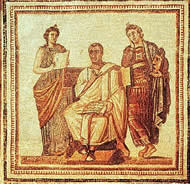
The picture is an example to Roman art. This picture depicts Zeus on his throne.
Chapter 5 Test rest of test
5 S.A. questions
3. Narrow minds love money.
5. The blame is mine, oh friend.
8. Please, take care of my duaghter.
9. Human life is punishment.
10. Is healthy enough for you?
A Soldier's Humor
"Our army is great, " a Persian says, "and becuase of the number of our arrows you will not see heaven!" Then a Spartan answered: "In shadow, therefore, we fight!" And Leonidas, king of the Spartans, shouts: "Fight with spirit, Spartans; Today, perhaps we shall dine among the dead!"
Chapter 5 Test
Future Ind. Act. for luadare
luadare-to praise
Sing.
luadabo
luadabis
luadabit
Plural
luadabimus
luadabitis
luadabunt
Future Ind. Act. for monere
monere-to advise, warn
Sing.
monebo
monebis
monebit
Plural
monebimus
monebitis
monebunt
Imperfect Ind. Act. for luadare
luadare-to praise
Sing.
luadabam
laudabas
luadabat
Plural
luadabamus
luadabatis
luadabant
Imperfect Ind. Act. for monere
monere-to advise, warn
Sing.
monebam
monebas
monebat
Plural
monebamus
monebatis
monebant
Present Ind. Act.
luadare-to praise
Sing.
luado
laudas
luadat
Plural
luadamus
luadatis
luadant
luadare-to praise
Sing.
luadabo
luadabis
luadabit
Plural
luadabimus
luadabitis
luadabunt
Future Ind. Act. for monere
monere-to advise, warn
Sing.
monebo
monebis
monebit
Plural
monebimus
monebitis
monebunt
Imperfect Ind. Act. for luadare
luadare-to praise
Sing.
luadabam
laudabas
luadabat
Plural
luadabamus
luadabatis
luadabant
Imperfect Ind. Act. for monere
monere-to advise, warn
Sing.
monebam
monebas
monebat
Plural
monebamus
monebatis
monebant
Present Ind. Act.
luadare-to praise
Sing.
luado
laudas
luadat
Plural
luadamus
luadatis
luadant
Wednesday, October 1, 2008
Jupiter

Jupiter is the king of the gods, sky, and weather.
He is also god of fate of men and nations, law, justice, and moral conduct.
He was widely worshipped across all of Rome.
He is praised in many sanctuaries and shrines.
Jupiter is normally portrayed as a regal, bearded man.
Jupiter's signature weapon was a lightning bolt and he usually had a royal scepter and eagle.
Little poem I just made up...
Jupiter, king of the sky,
Jupiter, ever so high,
was a god of moral conduct,
but why had he never had much moral conduct?
We do not know why,
that the king of the sky,
was never a truely good guy.
The Adventures of Io

Jupiter, king of the gods, was loving pretty Io, but was fearing Juno's anger. Therefore, he changed Io's form. "Juno will not see a woman, but a cow", Jupiter was thinking. Juno was not foolish. "You possess a gift, my man? You ought to give the pretty cow to Juno? Give it, if you do love me!" Therefore, Jupiter gave the cow to Juno. The cow was remaining with the great watchmen, Argus. Argus was having 100 eyes. Mercury overcame Argus, but Io was not yet free. a wicked gadfly was remaining with the cow. Io was wandering through the land. Many people were seeing, but Io was not having her own true form. Unfortunate woman! Will you always have the form of a cow? Is your penalty enough?
Juno's anger was not perpetual. Jupiter gave Io a human form; then Io gave birth to a son. The 100 eyes of Argus you will see on a peacock's tail.
Juno's anger was not perpetual. Jupiter gave Io a human form; then Io gave birth to a son. The 100 eyes of Argus you will see on a peacock's tail.
Monday, September 29, 2008
Sententiae Antiquae Chapter 5 evens
2. Danger, therefore, was remaining yesterday?
4. Overcome your spirits and anger.
6. Give pardon to our son and daughter.
8. Please, take care of my duaghter.
10. Are you healthy enough?
12. Your fame and glory will always remain.
4. Overcome your spirits and anger.
6. Give pardon to our son and daughter.
8. Please, take care of my duaghter.
10. Are you healthy enough?
12. Your fame and glory will always remain.
Vocab Quiz 5
1. adulescentia-youth
2. animus-spirit
3. caelum-sky, heaven
4. culpa-blame
5. gloria-glory
6. verbum-word
7. te-you
8. liber-free
9. noster-our
10. pulcher-beautiful
11. sanus-sane
12. igitur-therefore
13. propter-becuase of
14. cras-tomorrow
15. heri-yesterday
16. quando-when
17. satis-enough
18. tum-then
19. ceno-to dine
20. culpo-to blame
bonus
1. remeneo-to remain
2. supero-to be above
3. basium-kiss
4. bellum-war
5. consilium-counsel
Friday, September 26, 2008
Chapter 4 Test(S.A.and The Tragic Story of Phaethon
S.A. Chapter 4 #s 1-10(TEST)
1. Fortune is blind.
2. If there are truly dangers, you are unfortunate.
3. Greetings, oh friend; you are a good man.
4. Your son’s reputation is not pretty.
5. Making mistakes is human.
6. No one is wholly fortunate.
7. The cure to anger is delay.
8. Good Daphnis, my friend, loves the peaceful life of the farmer.
9. The teachers often give the little boys a cookie and gift.
10. I love my girlfriend more than my eyes.
The Tragic Story of Phaethon
Phaethon is the son of Phoebus. Phaethon’s friends doubted his divine origin, “You are not the son of the gods. You do not have godly powers. Your tale is not true. “Phaethon moved with great anger, “I am the son of the gods! Phoebus, give them a sign!” called Phaethon. Phoebus listened to his boy and without delay flew down from the heavens. “Oh my son, what do you desire?”Phoebus inquired. “Money? Wisdom? Life without anxiety?” Phaethon answered, “I desire to strap reins and drive the chariot of the son.” Oh, foolish boy! Evil is your counsel. You ought not to desire godly service. Phoebus warned his son, but the boy did not know the great danger on his life. The horse was powerful; Phaethon had no power. A chariot without a true master wanders in the heavens. What do we see? Phaethon falls down from the heavens. Oh, misfortune!
Chapter 4 Test paradigms
1. donum-gift
Singular Plural
donum dona
doni donarum
dono donis
donum dona
dono donis
2. consilium-counsel
Singular Plural
Consilium consilia
Consilii consiliarum
Consilio consiliis
Consilium consilia
Concilio consiliis
Singular Plural
donum dona
doni donarum
dono donis
donum dona
dono donis
2. consilium-counsel
Singular Plural
Consilium consilia
Consilii consiliarum
Consilio consiliis
Consilium consilia
Concilio consiliis
Wednesday, September 24, 2008
Sententiae Antiquae Chapter 4
Fortune is blind.
Greetings, oh friend; you are a good man.
To make mistakes is human.
The cure to anger is delay.
The teachers give to the small boys cookies and a gift.
Hello, my pretty girl-give to me many kisses, please!
My duty calls.
Greetings, oh friend; you are a good man.
To make mistakes is human.
The cure to anger is delay.
The teachers give to the small boys cookies and a gift.
Hello, my pretty girl-give to me many kisses, please!
My duty calls.
Monday, September 22, 2008
Vocab Quiz Chapter 4
1. basium-kiss
2. bellum-war
3. consilium-counsel
4. cura-care
5. donam-gift
6. exitium-destruction, ruin
7. magister-schoolmaster, schoolmistress
8. mora-delay
9. nihil-nothing
10. oculus-eye
Bonus:
officium-duty
otium-leisure
periculum-danger, risk
2. bellum-war
3. consilium-counsel
4. cura-care
5. donam-gift
6. exitium-destruction, ruin
7. magister-schoolmaster, schoolmistress
8. mora-delay
9. nihil-nothing
10. oculus-eye
Bonus:
officium-duty
otium-leisure
periculum-danger, risk
Sunday, September 21, 2008
MAJOR ROMAN DIETIES

These are the more popular Roman gods and goddesses, so I guess these were the cheerleaders and jocks of Mount Olympus High. Wait, does it work that way for gods? Maybe it is becuase of how important their powers were. That would mean Jupiter could have been a band geek. Burn!
Apollo-truthful god of light
Ceres-goddess of agriculture and marriage
Diana-hunter goddess of the moon and fertility
Juno-Queen of the goddesses
Jupiter-Ruler of the gods
Mars-god of war
Mercury-god of trade
Minerva-goddess of wisdom and learning
Neptune-god of the sea
Venus-goddess of love and beauty
Vesta-goddess of fire
Vulcan-god of fire, craftsmen, and blacksmiths
(in my opinion, the coolest of the Roman gods)
The Gods' favorite phrases
 If the gods ever had a product to sell, this would be the motto on the label.
Apollo-"Ad lucem" - Towards the light
Ceres-"Aio, quantitas magna frumentorum est" - Yes, that is a very large amount of corn
Diana-"Ex luna sapientia"-From the moon, knowledge
Juno-"Ad augusta per angusta" - To high places by narrow roads
Jupiter-"A Deo et Rege"-From God and the King
Mars-"Abyssuss abyssum invocat"-Hell calls hell
Mercury-"Appareo decet nihil munditia?" - Is it not nifty?
Minerva-"Accipere quam facere praestat injuriam" - It is better to suffer an injustice than to do an injustice
Neptune-"A mari usque ad mare"-From sea to sea
Venus-"Ab imo pectore"-From the bottom of the chest (from the heart)
Vesta-"In fortitudine ignis"-Courage in fire
Vulcan-"Ex igne victoria"-Out of fire, victory
Subscribe to:
Posts (Atom)