Website of the Gods!!!

This is a blog of the gods, Ancient Rome, the Gallic Wars, translations, and other Latiny stuff!

Friday, April 3, 2009

5 Heroes!

Hercules-The most popular of Greek heroes, Hercules was the essence of strength and manliness. Hercules was celebrated in stories, sculptures, paintings, and even the geography of the ancient world. This hero's life was non-stop action, from start to finish.
Beowulf-Beowulf is from the most important work of Old English literature. Beowulf is a Scandinavian prince who rids the Danes of the monster Grendel (half man, half fiend) and Grendel's mother. Fifty years later he is a king of his native land and fights the dragon who is against his people.
Knights Templar-The Knights Templar was a military religious order. It was also one of the three major orders of medieval Christian knights. This order was established after the First Crusade. The French gradn master Jacques de Molay confessed under torture, and the knights were all eventually burned at the stake.
Gilgamesh-Gilgamesh was a tyrannical Babylonian king who ruled the city of Uruk. His people disliked him and prayed to the gods about it. Enkidu was sent, and the two wrestled. There was no clear victor, so they became friends. He, advised by an elder, found the plant of eternal youth, but lost it to a serpent and later died.
Jesus-Jesus was born of the Virgin Mary, and is the Son of God. He taught of God's love. Jesus was crucified for our sins, and rose from the grave. He now lives in heaven with God.

The Olympics-Ancient Vs. Modern-With 6 Major Differences


The Ancient Greek Olympics are very different from the modern-day Olympics, but they still have the same general idea. The winners still gain the fame and glory. There are also no monetary prizes, as in the Ancient Olympics. Some ancient events also remain (discus, javelin, etc.) The French Baron Pierre de Coubertin also wished to regain the ideals of the Ancient Olympics in the new modern-day Olympics.

6 Major Differences
1. Only a few hundred of Greek descent could participate in the Ancient Greek games
The Salt Lake City Olympics featured 2600 athletes from 77 countries.
2. Only men could participate in the Ancient Olympics. It was even part of their citizen's education.
Now, women can participate in the modern-day Olympics. The first women to compete were Marie Ohnier and Mme. Brohy (they participated in croquet games in the 1900 Olympics)
3. The Ancient Olympic Games were a religious event to honor the Greek god Zeus (king of the gods). A hundred oxen were also given as a sacrifice.
Frenchman Pierre Baron de Coubertin, who helped revive the Olympic Games, insisted that they feature the international competition of athletes
4. The Ancient Olympic events only had one winner, who received the olive branch crown. A statue of him was also erected in Olympia
Now there are 15 types of events with a bronze, silver, and gold medal. People now don't die to win.
5. The Ancient Greeks never thought of the Winter Olympics.
The Winter Olympics are a modern invention. The first Winter Olympics was held in Chamonix, France
6. The Ancient Olympic Games were always held in Olympia.
They are now held at different places each year, with Greece only being the site of the 1st modern Olympic Games.

Chapter 17-Test

Practice and Review-1-10
1. Yes, "quae nos semper alunt" is a relative clause
2. No relative clause
3. No relative clause
4. Yes, "quae mentes nostras semper regere" and "qua valere" are relative clauses
5. Yes, "quam difficile est" is a relative clause
6. No relative clause
7. Yes, "quae eum saepe neglegebat" is a relative clause
8. No relative clause
9. No relative clause
10. No relative clause

On the Pleasures of Love in Old Age
Is love in old age? Truly, the pleasure is less, but less also is the desire. However, we worry nothing, if we do not desire, and he who does not desire does not lack. Youth desire excessively; the old often have enough love and much wisdom. I think, therefore, this time of life is pleasant.

Thursday, April 2, 2009

Riley and Ripple-The Roman Pillar Monster-Part 2

Chapter 17-Sententiae Antiquae-3 Pixtons

These are numbers 3, 4, and 5.
They translate to:
3. Many citizens either don't see the dangers which are imminent or they neglect what they see.
4. He who gives quickly gives twice.
5. He who has begun, the deed had been made half. Begin!


Chapter 17-Sententiae Antiquae-Noun Cases

1. Amice-Genitive or Nominative
2. Filium-Accusative
3. Dionysis-Dative or Ablative
4. Graecia-Nominative, Vocative, or Ablative
5. Siciliam-Accusative
6. Tempestatem-Accusative
7. Cives-Nominative or Accusative
8. Pericula-Nominative or Ablative
9. Facti-Nominative or Genitive
10. Fortuna-Nominative or Ablative
11. Fortuna-Nominative or Ablative
12. Fortuna-Nominative or Ablative
13. Victoria-Nominative or Ablative
14. Simulatio-Nominative
15. Veritatem-Accusative
16. Nomen-Nominative or Accusative
17. Virtutem-Accusative
18. Viri-Nominative or Genitive
19. Corpore-Ablative
20. Turbam-Accusative

Chapter 17-Sententiae Antiquae-Parsing Verbs

• Salve-2nd person singular imperative
• Commisi-1st person singular perfect active indicative of "commitere" meaning "untie"
• Dixi-1st person singular perfect active indicative of "dicere" meaning "to talk"
• Navigabat-3rd person singular imperfect active indicative of "navigare" meaning "to navigate"
• Imminent-3rd person singular present active indicative of "imminere" meaning "to threaten"
• Vident-3rd person plural present active indicative of "videre" meaning to "to see"
• Neglegunt-3rd person plural present active indicative of "neglegere" meaning "to neglect"
• Dat-3rd person singular present active indicative of "dare" meaning "to give"
• Coepit-3rd person singular perfect active indicative of "coeppesi" meaning "began"
• Habet-3rd person singular present active indicative of "habere" meaning "to have"
• Incipe-2nd person imperative of "incipere" meaning "to begin"
• Est-3rd person singular present active indicative of "esse" meaning "to be"
• Reposcit-3rd person singular present active indicative of "reposcere" meaning "to demand back"
• Dedit-3rd person singular perfect active indicative of "dare" meaning "to give"
• Facit-3rd person singular present active indicative of "facere" meaning "to make"
• Amat-3rd person singular present active indicative of "amare" meaning "to love"
• Est-3rd person singular present active indicative of "esse" meaning "to be"
• Facit-3rd person singular present active indicative of "facere" meaning "to make"
• Adiuvat-3rd person singular present active indicative of "adiuvare" meaning "to help"
• Vincit-3rd person singular present active indicative of "vincere" meaning "to conquer"
• Delet-3rd person singular present active indicative of "delere" meaning "to destroy"
• Valere-infinitive meaning "to be strong"
• Potest-3rd person singular present active indicative of "posse" meaning "to be able to"
• Amavi-1st person singular perfect active indicative of "amare" meaning "to love"
• Periit-3rd person singular perfect active indicative of "perire" meaning "to die"
• Vita-2nd person singular imperative
• Vive-2nd person singular imperative
• Facere-infinitive meaning "to make"
• Possunt-3rd person plural present active indicative of "posse" meaning "to be able to"
• Admitte-2nd person singular imperative
• Potes-2nd person singular present active indicative of "posse" meaning "to be able to"
• Facere-infinitive meaning "to make"

Tuesday, March 31, 2009

Latin Help-Parsing S.A. Chapter 17

• Salve-2nd person singular imperative
• Commisi-1st person singular perfect active indicative of "commitere" meaning "untie"
• Dixi-1st person singular perfect active indicative of "dicere" meaning "to talk"
• Navigabat-3rd person singular imperfect active indicative of "navigare" meaning "to navigate"
• Imminent-3rd person singular present active indicative of "imminere" meaning "to threaten"
• Vident-3rd person plural present active indicative of "videre" meaning to "to see"
• Neglegunt-3rd person plural present active indicative of "neglegere" meaning "to neglect"
• Dat-3rd person singular present active indicative of "dare" meaning "to give"
• Coepit-3rd person singular perfect active indicative of "coeppesi" meaning "began"
• Habet-3rd person singular present active indicative of "habere" meaning "to have"
• Incipe-2nd person imperative of "incipere" meaning "to begin"
• Est-3rd person singular present active indicative of "esse" meaning "to be"
• Reposcit-3rd person singular present active indicative of "reposcere" meaning "to demand back"
• Dedit-3rd person singular perfect active indicative of "dare" meaning "to give"
• Facit-3rd person singular present active indicative of "facere" meaning "to make"
• Amat-3rd person singular present active indicative of "amare" meaning "to love"
• Est-3rd person singular present active indicative of "esse" meaning "to be"
• Facit-3rd person singular present active indicative of "facere" meaning "to make"
• Adiuvat-3rd person singular present active indicative of "adiuvare" meaning "to help"
• Vincit-3rd person singular present active indicative of "vincere" meaning "to conquer"
• Delet-3rd person singular present active indicative of "delere" meaning "to destroy"
• Valere-infinitive meaning "to be strong"
• Potest-3rd person singular present active indicative of "posse" meaning "to be able to"
• Amavi-1st person singular perfect active indicative of "amare" meaning "to love"
• Periit-3rd person singular perfect active indicative of "perire" meaning "to die"
• Vita-2nd person singular imperative
• Vive-2nd person singular imperative
• Facere-infinitive meaning "to make"
• Possunt-3rd person plural present active indicative of "posse" meaning "to be able to"
• Admitte-2nd person singular imperative
• Potes-2nd person singular present active indicative of "posse" meaning "to be able to"
• Facere-infinitive meaning "to make"

Monday, March 30, 2009

Chapter 17-S.A. 1-12, Old Age Love

1. Greeting, good friend, to whom I united my son yesterday.
2. Dionysus, who spoke about this before, sailed from Greece to Sicily though a storm.
3. Many citizens either don't see the dangers which are imminent or they neglect what they see.
4. He who gives quickly gives twice.
5. He who has begun, the deed had been made half. Begin!
6. Fortune is easy: he demands back what he gives quickly.
7. Fortune makes foolish him whom she loves too much.
8. Not only is fortune blind, but it also makes those who it always helps blind.
9. He who conquers himself in victory conquers twice.
10. Pretense destroys truth, without which the name of friendship is not able to have power.
11. I truly loved that man's virtue, which did not perish with his body.
12. Avoid the crowd. Live with these men who are able to make you better; let in those whom you can make better.

On the Pleasures of Love in Old Age
Is love in old age? Truly the pleasure is less, but less also is desire. But nothing is a concern to us, if we are not desiring, and he who does not desire does not lack. Youths desire excessively; old men often have much love and wisdom. Therefore, I think that this time of life is pleasant.

Chapter 17 Vocab Quiz

1. libellus-little book
2. quae-who
3. caecus-blind
4. levis-light
5. aut-or
6. cito-quickly
7. quoque-also
8. admittere-to admit
9. coepi-began
10. cupio-to desire
11. deleo-to destroy

Sunday, March 29, 2009

Riley and Ripple-The Roman Pillar Monster-Part 1

Well, this may not seem like it, but this is going to have everything to do with Latin. You'll see after the next part comes out...

Friday, March 27, 2009

Verbs from The Myrmidons-Ant People Parsing

Regebat-3rd person singular imperfect active indicative of "regere" meaning "to rule"
Ceperat-3rd person singular pluperfect active indicative of "capere" meaning "to capture"
Iunxerat-3rd person singular pluperfect active indicative of "jungere" meaning "to join"
Tolerare-infinitve meaning "to tolerate"
Potuerat-3rd person singular pluperfect active indicative of "possum" meaning "to be able to"
Sensit-3rd person singular perfect active indicative of "sentire" meaning "to feel"
Tenuit-3rd person singular present indicative active of "tenere" meaning "to have"
Vivebant- 3rd person plural imperfect active indicative of "vivere" meaning "to live"
Misit- 3rd person singular perfect active indicative of "mittere" meaning "to send"
Vocavit- 3rd person singular present active indicative of "vocare" meaning "to speak"
Delevit- 3rd person singular present active indicative of "delere" meaning "to delete"
Neglegere- infinitive meaning "to neglect"
Debes- 2nd person singular present indicative active of "debere" meaning "ought"
Audivit- 3rd person singular present indicative active of "audivere" meaning "to hear"
Coepit-3rd person singular present indicative active of "coepessi" meaning "began"
Mutare- infinite meaning "to mutate"
Est-3rd person singular present indicative active of "sum" meaning "to be"
Fecit-3rd person singular perfect indicative active of "facere" meaning "to make"
Dico-1st person singular present indicative active of "dicere" meaning "to talk"
Erat-3rd person singular present indicative active of "sum" meaning "to be"

Thursday, March 26, 2009

The Myrmidons (Ant People)


Once upon a time, Aeacus was ruler of Aegina, whose name he took from his mother Aeaci, who at the time Jupiter joined her in love. Juno, who was not able to tolerate the bad morals of Jupiter, sensed this deed and kept the memory. Many years after this, she sent death to everyone who lived on the island. "Oh, father Jupiter," Aeacus called, "Juno destroyed my whole population! Help me, your son, who you love and you ought not to neglect." The god heard him and without delay began to mutate ants into humans! And so Jupiter, when nothing is too difficult, male small men and women out of animals. (Truth tells, can it not be?)
The son of Aeacus is Peleus, whose son is that man Achilles, the leader of the Myrmidons (Ant people)

Wednesday, March 25, 2009

20 Roman God/Goddess/Hero sentences (with relative clauses)

1. Apollo, who is the god of light, is very truthful.
2. Ceres, who is the goddess of agriculture and marriage, just helped a farm grow.
3. Diana, who is a hunter goddess, is also a goddess of the moon and fertility.
4. Juno, who is the queen of the gods, just smote a man.
5. Jupiter, who is the king of the gods, just killed a hydra.
6. Mars, who is the god of war, liked the Trojan War for its bloody onslaughts.
7. Mercury, who is the god of trade, just sold me a diamond sword.
8. Minerva, who is the goddess of wisdom and learning, just beat my in chess...with one move.
9. Neptune, who is the god of the sea, is also the god of horses, cyclopes, and earthquakes.
10. Venus, who is the goddess of love and beauty, just swayed my heart.
11. Vesta, who is the goddess of fire, just insulted Vulcan.
12. Vulcan, who is the god of fire, is a craftsmen and a blacksmith who just smacked Vesta.
13. Perseus, who is a great hero, just slayed Medusa.
14. Hercules, who is also a great hero, slayed many a creature.
15. Bellerophon, who is one of the greatest heroes, captured and taed Pegasus.
16. Achilles, who is another hero, battled in the Trojan War.
17. Aeneas, who was also at Troy, is the hero of the Illiad and the Aeneid.
18. Theseus, who was an Athenian hero, kllled the Minotaur.
19. Jason, who lead the Agronauts, rocked.
20. Ajax, who is a hero, battled in the Trojan War

Friday, March 20, 2009

Roman Work


Romans woke up early and usually worked a six hour day. Free men and freedman were usually out on their business the whole morning, contributing to the bustle of the urban activity. The import business was centered in Ostia. The biulding industry was the reason for the continual supply of skilled labor. This took teh form of architects, surveyors, supervisors, foremen, sculpters, stonemasons, carpenters, and brickworks' managers.

In the cities and towns, retail and wholesale shops operated, craftsmen plied their trades, and little shops, taverns, and inns did their own business. They, in turn, were supplied with raw materials and foodstuffs from the agricultural activity on estates. Sons tended to follow their father's trade, and the only respectable jobs in the upper class involved law and politics. Other fields involved the work of freedmen, so were lower. These included architecture, medicine, surgery, dentistry, teachingm and agricultural management. This left a sizeable group of educated (if not always aristocratic) people unemployed.

After the daily work routine, a visit to the public baths was usual, for men and as well as women.

(for more on baths, see Roman Baths post)

Roman Circus


The Romans adapted the idea of the Greek Hippodrome to become the Roman Circus. The term is applied to the events that occurred inside of the enclosure. Combat between gladiators, wild beasts, and gladiators and wild beasts, which were usually held in an amphitheater, were sometimes also held in circuses. Many tiers of seat surrounded the circus, except at one end. At this end the stalls for the horses and chariots were located. In the center of the circus, extending lengthwise almost end to end, was a low wall called the spina. The riders and charioteers rode around this wall.

The Roman populace often demanded "bread and circuses" from their political candidates. They wanted sustenance and entertainment. The Roman general Pompey the Great is said to have (in 55 BC) sponsored 5 days of circus games. In this length of time, 500 lions and 20 elephants were killed.

Later (from the Fall of teh Roman Empire to the end of the Renaissance), the Roman circuses were gradually torn apart for their building stones. Few traces of these circuses remain.

Capitoline Hill-Titus' Tour


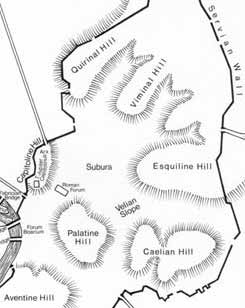
I, Titus Tullius Sextus, finished my porridge and bread, wiped my mouth, strapped on my boots, and adjusted my toga. I stood and looked at the surrounding landscape, which went on as far as the eye could see, past buildings and fields. I sighed. Another long day would be ahead of me. I would first go to the Temple of Veiovis to worship (where I wondered every day why the cella was wider than the front porch), and then I would walk my often-trodden path to the Asylum to give tours of Capitolinus Mons (Capitoline Hill).
This was my job, to appeal to the strangers that entered the Asylum daily, to draw the interest of the travelers from afar. "Titus the Tour Guide" was my title. I would take my customers on a tour of the Asylum and Capitoline Hill, for a fair pay, which provided me with enough for my living.
I am a very knowledgeable guide, or at least I like to think so, but I am getting bored of the same old thing, day after day, rote recitation and routes. I long for something better, something new. I have a feeling this was my lucky day.
I was standing at the main entrance area of the Asylum, watching as the travelers from afar wandered through. I knew by now the right people to pick out. I looked for three things in a potential customer. For one, they could not be weary and tired, for they would never accept to the tour. For two, they should not be walking with purpose, because he could not interrupt their planned travels. For three, they must have enough payment for the tour.
I soon spotted a potential customer who was walking in my direction, or rather, I was spotted by a potential customer who was walking in my direction. This wasn’t normal, but I did my normal spiel of appeal for my tour. The customer was only too anxious, but he also seemed to be nervous. He was quickly looking both ways as if he was making sure he wasn’t followed. I didn’t catch this, so when the shady customer agreed and provided payment, I was only too happy to take this traveler on my first tour of the day.
I always began my tour on the Arx, the northern summit of the hill, which was the higher point of Capitoline Hill. The tour literally only went downhill from there. On the way to the Temple of Juno Moneta I spewed general information about the hill.
“The Capitoline Hill is the smallest of the seven hills of Rome. It is surrounded by steep cliffs on all sides except in the southeast where it is accessible from the Roman Forum. It is located between the Forum and the Campus Martius. It is also the religious center of the city. The northern and southern summits of the hill are divided by the Asylum, which is where we just came from. South of the Asylum are a few other temples, the most prominent of which is the Temple of Jupiter Optimus Maximus. The Capitoline Hill was a site for this temple for the Capitoline Triad, which are Jupiter, Juno, and Minerva. The temple was started under the rule of Rome’s fifth king Tarquin the Elder. Legend says that the recovery of a human skull (“head” in Latin is “caput”) while foundation trenches were being dug led to the name of the hill. When the Senones Gauls raided Rome in 390 BC, this was the one section of the city that evaded capture by the barbarians. Julius Caesar and the brother and nephew of Vespasian also visited this hill. Also-“
“Excuse me”, the shady traveler interjected. “Can you tell me more about the Asylum?”
“I was getting to that”, I answered. “The Asylum is a grove in the depression between the two summits of Capitoline Hill (the Arx and the Capitolium). An asylum can be any place offering safety, shelter, and protection. Tradition states that Romulus invited visitors, settlers, and refugees from afar in the Asylum. This began Rome’s policy of encouraging a diverse population.”
We arrived at the Temple of Juno Moneta. “This is a temple for Juno ‘who warns’. The Roman Mint is located here.” I then showed the stranger the amazing architecture including the marble columns and arches of the temple and then I showed him where the money was made.
When we were both finished, I told the stranger where we would travel next. We were going to the Capitolium to visit the Temple of Jupiter Optimus Maximus, the Temple of Fides, and the Aedes Tensarum. The Aedes Tensarum was first. I answered the traveler’s questions as we walked over. We strolled along as many others were busily hurrying all around. A sweet wind blew, which brightened my mood. I couldn’t get over the fact that the traveler man was jittery the whole time. I tried to wave it off in the back of my mind. When we arrived at the Aedes Tensarum, I began again.
“The Aedes Tensarum is a small temple where symbols of the gods during the theater festivals are stored. Chariots are also housed here.” We then walked to the Temple of Fides, saving the Temple of Jupiter Optimus Maximus for last. On the way to the temple of Fides, I saw a Roman man with a something sharp in his toga and wondered why he looked so mischievous. The traveler then clumsily bumped into him, and we continued on.
At the Temple of Fides I told the man, “This temple is dedicated to the goddess Fides.” I then went on to explain to him that this temple was different in its colorful archaic features. One such requirement was that the priests had to wrap their hands to symbolize the sacred nature of oaths. Senators also met here.
When we arrived at the Temple of Jupiter Optimus Maximus, I felt like I had already told him a lot about it. As I began to tell the man of the highlights of the temple, an actual light appeared near the altar. I walked over to check it out as the light turned into some kind of swirling portal to another area. I turned to wonder aloud to the man, but as I did he drew a knife. He must have pick pocketed it from the man near the Temple of Fides. He stared at me deviously. I looked at him closer and saw the uniform underneath his clothes. “You must have escaped from Carcer”, I said. Carcer was the ancient state prison of Rome at the bottom of the Capitoline Hill. He told me the truth, “Yes, then I stole a uniform from a man at the Temple of Concord. And before you ask, I am killing you to take your place and blend in. I will become you and will never be found.” He glared hungrily at me. On any other day I would have stayed away from the colorful tunnel, but today I spun and dove straight into it.
In the tunnel I wondered why such a portal would open up for me. I came out the other side of the tunnel in a familiar place. It was Capitoline Hill, but it was run down and looked old. I walked outside, confused, and asked the closest person I could see what happened. He told me that the temples were over a thousand years old and that this ruin was bound to happen sometime.
I questioned him again. “What year is this?”
The man answered, “1536.”
My pride for the Hill overtook my confusion of time, place, etc. I told him, “I need to find the nearest architect to fix these buildings.”
He raised his hand slowly and looked down. “I’m an architect”, he said. He looked sad.
“Well great! You can help rebuild and improve these places. I can even help you with them.” He still looked sad. “Come on”, I begged him. “Please, you must help me. This place has a huge historical importance. You must help.”
He finally agreed. “Glad to do business with you”, I said to the man. “My name is Michelangelo”, he said. “And I’m glad to help, too!”
Years passed. The church of Santa Maria de Aracoeli was built at the Arx. The Piazza del Campidoglio and the surrounding palazzos were designed by Michelangelo, who decided to orient the Capitoline towards St. Peter’s Basilica. Still, the Hill was restored, so I was satisfied. Capitoline Museums then opened. I helped bring back the Capitoline. I decided that my purpose of coming into the future must have been to start off Michelangelo. This always confused me. And when I figured out that Rome was gone I almost died, but hey, this was a new start, just like I wanted…

Information Bibliography:
"Capitoline Hill." Wikipedia.org. Wikipedia. http://en.wikipedia.org/wiki/Capitoline_Hill.
"Capitoline Hill." Rome Reborn. Institute for Advanced Technology in the Humanities.
http://www.romereborn.virginia.edu/ge/GF-006.html.
"Asylum." Rome Reborn. Institute for Advanced Technology in the Humanities.

Picture Bibliography:
http://www.ancient-rome.com/images/7hills.jpg
http://www.sacred-destinations.com/italy/rome-capitoline-museum-pictures/eosa_032.jpg
Google Earth Screenshots. Digital image. Google Earth.

Saturday, March 14, 2009

Roman Calendars-A Contribution to Today


The original Roman calendar was chaotic. It included 10 months and 304 days in a year that started with March. Two more months, January and February, were added later that century. Because these months were only 29 or 30 days long, an extra month had to be added about every second year. The days of the month had an awkward method of counting backward from three days: the calends (1st of the month), the ides (the middle of the month, occurring on the 13th sometimes and on the 15th the other times), and the nones (the ninth day before the ides). This was then even more hopelessly confused when officials abused their authority to prolong their terms in office or to hasten or delay elections. In 45 BC, Julius Caesar was advised by the Greek astronomer Sosigenes to use a solar calendar. This calendar became known as the Julian Calendar and fixed the year with 365 days and 366 days every 4th year. This was called a leap year. This order was established as it is known in everyday calendars. In 44 BC Caesar changes the name of the month Quintilis to Julius(July)after himself. Then the month Sextilis was renamed after the Roman Emperor Caesar Augustus (August). The Romans named the days of the week in honor of the sun, moon, and various planets.

Friday, March 13, 2009

Basic Capitoline Hill Story

My name is Titus Tullius Sextus. I work at the Asylum in ancient times. I will be meeting people as they come in, walking around the hill after work, etc.

Latin Phone Numbers!

1410 817 4765-MCDX DCCXVII MMMMDCCLXV
1443 677 3059-MCDXLIII DCLXXVII MMMLIX
1443 564 8456-MCDXLIII DLXIV MMMMMMMMCDLVI
MMMMMMMMMCMXCIX
Football-superbowl
Bottom of sheet music
Clocks
Outlines _
5,000- V _
100, 000- X _
500, 000- D _
1,000,000- M