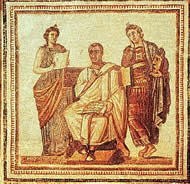
Marius was the first man in his family to hold high office, so was a novus homo. He was elected tribune, quaestor, praetor, and consul (7 times). He married a patrician family, and marries the aunt of Julius Caesar.Marius is known for dramatic reforms of the Roman armies. Marius authorized the recruitment of landless citizens, and reorganized legions in Rome.
Sulla was a patrician family that fell on hard time. Sulla was a Roman general and politician. Sulla had a reputation for always supporting the Senate. Sulla started proscriptions (lists of people to be killed for a reward). Sulla also started political reforms. Sulla was later referred to by Machiavelli as the ideal characteristics of a ruler.
Both Marius and Sulla were involved in the Social War.
These rulers are seen as a precedence to Caesar, as they both caused dramatic reforms, and Caesar would also cause a dramatic change in Rome. Caesar was also a militaristic leader, and Marius' reforms aided him. Caesar also used the proscriptions of Sulla to eliminate his enemies. Marius and Sulla started an age of reforming in Rome, which was continued by Caesar to the end of the Roman Republic.
Sources: http://ocw.nd.edu/classics/history-of-ancient-rome/marius-vs.-sulla-romes-social-wars
http://en.wikipedia.org/wiki/Julius_Caesar
Pictures: http://www.vroma.org/images/raia_images/marius.jpg
http://www.colorado.edu/Classics/clas4091/Graphics/Sulla.jpg
Sorry, the pictures failed on this post, as Blogger wouldn't take them, so I have to go back and edit it tonight.
Tuesday, January 19, 2010

Monday, January 18, 2010
Leto-Who

Picture: http://www.theoi.com/image/greek-titans-leto.jpg
Friday, January 15, 2010
Why did the immortal Chiron die?-Why

Picture: http://www.theoi.com/Cat_Astraioi.html
Wednesday, January 13, 2010
BIG THING Part 2
The Gallic Wars, Wins and Losses
This project is on the Gallic war, and traces the victories and defeats of Caesar and his army along the way.Be aware when grading that this was done in 30 min, with Firefox going into "Not Responding" every 30 seconds. There were also loads of formatting problems, which was out-of-the-blue. Grading should be based on quality of information presented, but go easy on it...
Translation from Caesar's Gallic Wars
"All of Gaul is divided into three parts, one of which the Belgae live in, the Aquitani live in another, and those who in their own language are called Celts, in our language called Gauls, the third. These all differ from each other in customs, laws, and language. The river Garonne separates the Gauls from the Aquitani; the Marne and the Seine separate them from the Belgae."

Sources:
-Caesar, Julius. ""De Bello Gallico" and Other Commentaries by Julius Caesat." Project Gutenberg. Project Gutenberg. Web. 13 Jan. 2010. <http://www.gutenberg.org/catalog/world/readfile?fk_files=44511&pageno=11>.
-"Gallic Wars." Wikipedia. Wikipedia. Web. 13 Jan. 2010. <http://en.wikipedia.org/wiki/Gallic_Wars>.
-Gill, N. S. "The Winners and Losers of Casesar's Gallic Wars." About.com. About.com. Web. 13 Jan. 2010. <http://ancienthistory.about.com/od/caesa1/tp/gallicwarswinners.htm>.
The picture depicts Vercingetorix surrendering to Caesar.
This project is on the Gallic war, and traces the victories and defeats of Caesar and his army along the way.Be aware when grading that this was done in 30 min, with Firefox going into "Not Responding" every 30 seconds. There were also loads of formatting problems, which was out-of-the-blue. Grading should be based on quality of information presented, but go easy on it...
Translation from Caesar's Gallic Wars
"All of Gaul is divided into three parts, one of which the Belgae live in, the Aquitani live in another, and those who in their own language are called Celts, in our language called Gauls, the third. These all differ from each other in customs, laws, and language. The river Garonne separates the Gauls from the Aquitani; the Marne and the Seine separate them from the Belgae."
The Gallic Wars were a series of military campaigns waged by Caesar against several Gallic tribes, lasting from 58-51 BC. These wars paved the way for Caesar to become the sole ruler of the Roman Republic. The campagin was painstakingly described by Caesar in his commentary, Commentarii De Bello Gallico, which is an important historical source.

1. the Batlle of Bibracte-The Romans won in 58 BC under Julius Caesar, who defeated the Helvetii under Orgetorix.2. Vosges- Another win by Caesar in 58 BC, who defeated the Germans under Ariovistus. 3. Sabis River-Another Roman win by Caesar, but in 57 BC, and a loss by the Nelvii.4. Morbihan Gulf-56 BC win by the Romans' naval fleet under D. Junius Brutus, who defeated the Veneti. They were punished severely.5. Gallic Revolts-54 BC-During the revolts was the first major Roman defeat in Gaul, but in the end, the Roman troops under Labienus defeated the Treveri troops.6. Battle at Gorgovia-Gaul victory under Vercingetorix in 52 BC.7. Battle of Lutetia Parisorium-Roman victory under T. Labienus. 8. Battle near Dijon-Another Roman victory by Julius Caesar and a defeat of Vercingetorix.9. Battle at Alesia-decisive Roman victory. Julius Caesar victory over Vercingetorix.
Sources:
-Caesar, Julius. ""De Bello Gallico" and Other Commentaries by Julius Caesat." Project Gutenberg. Project Gutenberg. Web. 13 Jan. 2010. <http://www.gutenberg.org/catalog/world/readfile?fk_files=44511&pageno=11>.
-"Gallic Wars." Wikipedia. Wikipedia. Web. 13 Jan. 2010. <http://en.wikipedia.org/wiki/Gallic_Wars>.
-Gill, N. S. "The Winners and Losers of Casesar's Gallic Wars." About.com. About.com. Web. 13 Jan. 2010. <http://ancienthistory.about.com/od/caesa1/tp/gallicwarswinners.htm>.
The picture depicts Vercingetorix surrendering to Caesar.
BIG THING-Part 1
Honors Latin II
Midterm Big Thing
R. Richard Wojewodzki
Part I – paradigms and vocab (1 point each)
Please conjugate the following:
1. Present Active Subjunctive of laudare (laudem)
laudem
laudes
laudet
laudemus
laudetis
laudent
2. Present Active Subjunctive of monere (moneam)
moneam
moneas
moneat
moneamos
moneatis
moneant
3. Present Active Subjunctive of agere (agam)
agam
agas
agat
agamus
agatis
agant
4. Present Active Subjunctive of audire (audiam)
audiam
audias
audiat
audiamus
audiatis
audiant
5. Present Active Subjunctive of capere (capiam)
capiam
capias
capiat
capiamus
capiatis
capiant
6. Present Active Subjunctive of esse (sim)
sim
sis
sit
simus
sitis
sint
7. Present Active Subjunctive of posse (possim)
possim
possis
possit
possimus
possitis
possint
8. Imperfect Active Subjunctive of posse (possem)
possem
posses
posset
possemus
possetis
possent
9. Future Indicative Active of agere (agam)
agam
ages
aget
agemus
agetis
agent
10. Perfect Indicative Active of agere (egi)
egi
egisti
egit
egimus
egistis
egerunt
11. Perfect Indicative Active of audire (audivi)
audivi
audivisti
audivit
audivimus
audivistis
audiverunt
12. Pluperfect Indicative Active of capere (ceperam)
ceperam
ceperas
ceperat
ceperamus
ceperatis
ceperant
13. Future Perfect Indicative Active of laudare (laudavero)
lauvero
laudveris
laudaverit
laudaverimus
laudaveritis
laudaverunt
Please decline the following:
14. porta, -ae
porta
portae
portae
portam
porta
portae
portarum
portis
portas
portis
15. amicus, -i
amicus
amici
amico
amicum
amico
amici
amicorum
amicis
amicos
amicis
16. puer, -i
puer
pueri
puero
puerum
puero
pueri
puerorum
pueris
pueros
pueris
17. donum, -i
donum
doni
dono
donum
dono
dona
donorum
donis
dona
donis
18. rex, regis
rex
regis
regi
regem
rege
reges
regum
regibus
reges
regibus
19. corpus, corporis
corpus
corporis
corpori
corpus
corpore
corpora
corporum
corporis
corpus
corporis
20. civis, civis
civis
civis
civi
civem
cive
cives
civium
civibus
cives
civibus
21. urbs, urbis
urbs
urbis
urbi
urbem
urbe
urbes
urbium
urbibus
urbes
urbibus
22. mare, maris
mare
maris
mari
mare
mari
maria
marium
maris
maria
maris
23. fructus, -us
fructus
fructus
fructui
fructum
fructu
fructus
fructorum
fructis
fructas
fructis
24. dies, -ei
dies
diei
diei
diem
die
dies
dierum
dieis
dieas
dieis
25. hic, haec, hoc (masc, fem, and neut)
hic haec hoc
huius huius huius
huic huic huic
hunc hanc hoc
hoc hac hoc
hi hae haec
horum harum horum
his his his
hos has haec
his his his
Please write the corresponding English translation of each:
26. moenia, moenium-city walls
27. osculum, -i-eye
28. respondeo, -ere-to respond
29. cedo, -ere-to bring
30. stella, -ae-stars
31. expleo, -ere-to explore
32. luna, -ae-moon
33. princeps, principis-first
34. superus, -a, -um-above
35. sol, solis-sun
36. mensa, -ae-table
37. nox, noctis-night
38. caput, capitis-head, leader
39. nemo-nobody
40. capio, -ere-to seize
41. dico, -ere-to say
42. fugio, -ere-to flee
43. sapiens, sapientis-wise
44. ferox, ferocis-fierce
45. duco, -ere-to lead
46. credo, -ere-to believe
47. expello, -ere-to expel
48. labor, laboris-labor, work
49. neco, -are-to murder, kill
50. discipula, -ae-pupil
51. tollo, -ere-to endure
52. remaneo, remanere-to remain
53. otium, -ii-peace
54. sapientia, -ae-wisdom
55. vir, viri-man, hero
56. hodie-today
57. antiqua, -ae-ancient
58. pecunia, -ae-money
59. cogito, -are-to think
60. senatus, -us-the senate
Translation and Parsing (10 points each -- I'll take your best four.)
Please render a literal translation of the following and ID/parse each verb.
No dictionary.
You may use Twitter as a lifeline between yourselves; I shall be watching the feed and if it seems as though you are using it as a crutch, you'll be blocked -- so use it only in moderation.
1. An Philippus, rex Macedonum, voluisset Alexandro, filio suo, prima elementa litterarum tradi ab Aristotele, summo eius aetatis philosopho, aut hic suscepisset illud maximum officium, nisi initia studiorum pertinere ad summam sapientissime credidissent?
-- Quintillian Institutiones Oratoriae 1.1.23. – an, interrog. conj. ‘or’ / ‘can it be that’. – Macedones, -donum m. pl. ‘Macedonians’. – pertinere ad ‘to relate to’ / ‘affect’. – summa, -ae ‘highest part’
Can it be that Philippus, the king of the Macedonians, [verb] Alexandro, his son, the first [elementa] of letters [tradi] to Aristotle, thighest of ancient philosophy, but this man [suscepisse] to that highest office, [nisi] [initia] of the students to related to the highest part of wisdom they can believe?
2. Nunc videtis quantum scelus contra rem publicam et leges nostras vobis pronuntiatum sit. -- Cicero
Now you see [quantum] sins against the republic and you choose ours you might pronounce.
3. Asia victa, dux Romanus felix multos servos in Italiam misit. – Pliny the Elder
Asia having been conquered, the happy leader of the Romans sent many servants in
to Italy.
4. Vivamus mea Lesbia, atque amemus,
rumoresque senum severiorum
omnes unius aestimemus assis!
soles occidere et redire possunt:
nobis cum semel occidit brevis lux,
nox est perpetua una dormienda.
da mi basia mille, deinde centum,
dein mille altera, dein secunda centum,
deinde usque altera mille, deinde centum.
dein, cum milia multa fecerimus,
conturbabimus illa, ne sciamus,
aut ne quis malus inuidere possit,
cum tantum sciat esse basiorum.
omnes unius aestimemus assis!
soles occidere et redire possunt:
nobis cum semel occidit brevis lux,
nox est perpetua una dormienda.
da mi basia mille, deinde centum,
dein mille altera, dein secunda centum,
deinde usque altera mille, deinde centum.
dein, cum milia multa fecerimus,
conturbabimus illa, ne sciamus,
aut ne quis malus inuidere possit,
cum tantum sciat esse basiorum.
-- Catullus 5
We live and we love, my Lesbia
rumors and [senum severiorum]
all [unius] we estimate [assis]!
they are only able to [occidere] and [redire]
with our [semel occidit] brief light,
night is perpetual in sleep.
Give to me a thousand kisses, then one hundread,
then another thousand, then a second hundred,
then [usque] another thousand, then one hundred.
Then, we will make many with [milia],
we will [conturbabimus] that man, we will not know,
but which he is not able to [inuidere] bad,
with much he knows to be kisses.
5. Themistocles ad (bellum Corcyraeum) gerendum praetor a populo
factus, non solum praesenti bello sed etiam reliquo tempore
ferociorem redidit civitatem. Nam cum pecunia publica, quae ex
metallis redibat, largitione magistratuum quotannis interiret, ille
persuasit populo ut ea pecunia classis centum navium
aedificaretur. Qua celeriter effecta primum Corcyraeos fregit,
deinde maritimos praedones consectando mare tutum reddidit.
-- Nepos
Themistocles waged (the Corcyraeum War) as the population made him praetor, not the only [praesenti] war but even I relinquish time to his fierce [redidit] of the state. [Nam] with the public money, which he [redibat] from out of the metal mines, [largitione] the teacher [quptannis interiret] that he persuaded the population and his money [classis] one hundred ships to be [aedificaretur]. Which sharp effect the the Corcyraeos first [fregit], and then the maritime [praedones] I [consectando] the sea [tutum reddidit].
Tuesday, January 12, 2010
38 Latin Parses for EC on MidTerm
LATIN-ID and parse all verbs in 38 Latin, 21-28, then summarize each in a two to three sentence description
-for 5% ec on exam Wed
- The Golden Age Returns: This is a passage from one of Virgil's Eclogues. The Fourth Eclogue depicts the return of a golden age. It is sometimes called "Messianic" because Christians in the Middle Ages identified the "puer" of the poem with Christ.
Parsed Verbs:
- Incipit-3rd person singular present active indicative of "incipere" meaning "to begin"
- Erunt-3rd person plural future active indicative of "esse" meaning "to be"
- Venit-3rd person singular present active indicative of "venire" meaning "to come"
- Liberabitur-3rd person singular future passive indicative of "liberare" meaning "to free"
- Videbit-3rd person singular future active indicative of "videre" meaning "to see"
- Videbitur-3rd person singular future passive indicative of "videre" meaning "to seem"
- Reget-3rd person singular future active indicative of "regere" meaning "to direct"
- Feret-3rd person singular future active indicative of "ferre" meaning "to bring"
- Poterit-3rd person singular future active indicative of "posse" meaning "to be able to"
- Parabunt-3rd person plural future active indicative of "parare" meaning "to prepare"
- Cicero Reports his Victory Over Catiline: This is an excerpt from one of Cicero's four speeches against Catiline. Cicero has driven Catiline out of Rome. He now triumphantly reports to his fellow citizens what has happened.
Parsed Verbs:
- Cogitare-present active infinitive meaning "to think"
- Espulsus est-3rd person singular perfect passive indicative of "expellere" meaning "to expel"
- Timebatur-3rd person singular imperfect active indicative of "timere" meaning "to fear"
- Continebatur-3rd person singular imperfect active indicative of "continere" meaning "to contain"
- Manebunt-3rd person plural future active indicative of "manere" meaning "to remain"
- Mittetur-3rd person singular future passive indicative of "mittere" meaning "to throw"
- Videntur-3rd person plural present passive indicative of "videre" meaning "to seem"
- Esse-present active infinitive meaning "to be"
- Aluerunt-3rd person plural present active indicative of "alere" meaning "to nourish"
- Agere-present active infinitive meaning "to drive"
- Watching the Orator at Work: This passage from the Brutus, a survey of Roman oratory, describes the effect that an accomplished speaker has on his audience. Cicero is the speaker.
Parsed Verbs:
- Surgit-3rd person singular present active indicative of "surgere" meaning "to rise"
- Occupatur-3rd person singular present passive indicative of "occupare" meaning "to gain"
- Audire-present active infinitive meaning "to hear"
- Significant-3rd person plural present active indicative of "significare" meaning "signify"
- Vertuntur-3rd person plural present passive indicative of "vertere" meaning "to turn"
- Tangit-3rd person singular present active indicative of "tangere" meaning "to touch"
- Cupit-3rd person singular present active indicative of "cupere" meaning "to desire"
- Moveri-present passive infinitive meaning "to move"
- Terrentur-3rd person plural present passive indicative of "terrere" meaning "to frighten"
- Flent-3rd person plural present active indicative of "flare" meaning "to fly"
- Iudicare-present active infinitive meaning "to judge"
- Poteris-2nd person singular future active indicative of "posse" meaning "to be able"
- Videbis-2nd person singular future active indicative of "videre" meaning "to see"
- Caret-3rd person singular present active indicative of "carare" meaning "to lack"
- Potest-3rd person singular present active indicative of "posse" meaning "to be able to"
- Movere-present active infinitive meaning "to move"
- Videbuntur-3rd person plural future passive indicative of "videre" meaning "to be"
- Tenebuntur-3rd person plural future passive indicative of "tener" meaning "to have"
- Caesar's Camp is Attacked by Belgians: This is a excerpt from Caesar's commentaries on the Gallic Wars (58-51 BC). It is written in an objective third person style, but puts emphasis on Caesar's skill and courage.
Parsed Verbs:
- Ducebat-3rd person singular imperfect active indicative of "ducere" meaning "to lead"
- Collocaverat-3rd person singular pluperfect active indicative of "collocare" meaning "to put together"
- Sunt-3rd person plural present active indicative of "esse" meaning "to be"
- Commiserunt-3rd person plural perfect active indicative of "committere" meaning "to bring together"
- Recipiebant-3rd person plural imperfect active indicative of "recipere" meaning "to recover"
- Faciebant-3rd person plural imperfect active indicative of "facere" meaning "to make"
- Audebant-3rd person plural imperfect active indicative of "audere" meaning "to hear"
- Coeperunt-3rd person plural perfect active indicative of "coepere" meaning "to begin"
- Latebant-3rd person plural imperfect active indicative of "latere" meaning "to lie hidden"
- Provolaverunt-3rd person plural perfect active indicative of "provolare" meaning "to fly out"
- The Character of Catiline's Followers: This is a passage from the second of four speeches from Cicero against Catiline. Although Catiline is already gone, several of his followers remain, and Cicero assumes they are also a threat to the security of the state.
Parsed Verbs:
- Dicimus-1st person plural present active indicative of "dicere" meaning "to say"
- Dicit-3rd person singular present active indicative of "dicere" meaning "to say"
- Interest-3rd person singular present active indicative of "intersum" meaning "to concern"
- Timeo-1st person singular present active indicative of "timere" meaning "to terrify"
- Sunt-3rd person plural present active indicative of "esse" meaning "to be"
- Dicimus-1st person plural present active indicative of "dicere" meaning "to say"
- Parantur-3rd person plural present passive indicative of "parare" meaning "to prepare"
- Est-3rd person singular present active indicative of "esse" meaning "to be"
- Habent-3rd person plural present active indicative of "habere" meaning "to have"
- Possunt-3rd person plural present active indicative of "posse" meaning "to be able to"
- Possunt-3rd person plural present active indicative of "posse" meaning "to be able to"
- Est-3rd person singular present active indicative of "esse" meaning "to be"
- Premuntur-3rd person plural present passive indicative of "premere" meaning "to press"
- Expectant-3rd person plural present active indicative of "expectare" meaning "to expect"
- Posse-present active infinitive meaning "to be able to"
- Putant-3rd person plural present active indicative of "putare" meaning "to think"
- Sperandum est-3rd person singular present passive indicative of "sperare" meaning "to hope"
- Intellegendum est-3rd person singular present passive indicative of "intellegere" meaning "to understand"
- Vigilare-present active infinitive meaning "to be vigilant"
- Providere-present active infinitive meaning "to provide"
- Esse-present active infinitive meaning "to be"
- Esse-present active indicative meaning "to be"
- Sperant-3rd person plural present active indicative of "sperare" meaning "to hope"
- The Virtues of the Orator Cato: This is another excerpt from the Brutus in which Cicero laments that his contemporary orators show no interest in the "old fashioned" works of Cato. He also states how they are eager to imitate the Greek style or orators from earlier centuries.
Parsed Verbs:
- Sunt-3rd person plural present active indicative of "esse" meaning "to be"
- Legit-3rd person singular present active indicative of "legere" meaning "to read"
- Novit-3rd person singular perfect active indicative of "noscere" meaning "to learn"
- Mitto-1st person singular present active indicative of "mittere" meaning "to throw"
- Quaerimus-1st person plural present active indicative of "quaerere" meaning "to seek"
- Invenientur-3rd person plural present passive indicative of "invenire" meaning "to come upon"
- Habent-3rd person plural present active indicative of "habere" meaning "to have"
- Amantur-3rd person plural present passive indicative of "amare" meaning "to love"
- Ignoratur-3rd person singular present passive indicative of "ingorare" meaning "to disregard"
- Est-3rd person singular, present active indicative of "esse" meaning "to be"
- Loquebantur-3rd person plural imperfect passive indicative of "loquor" meaning "to speak"
- Esse-present active infinitive meaning"to be"
- Quaerendum esse-present passive infinitive meaning "to seek"
- Est-3rd person singular present active indicative of "esse" meaning "to be"
- Est-3rd person singular present active indicative of "esse" meaning "to be"
- Delectantur-3rd person plural present passive indicative of "delectare" meaning "to delight"
- Noverunt-3rd person plural perfect active indicative of "noscere" meaning "to learn"
- Volunt-3rd person plural present active indicative of "velle" meaning "to wish"
- Esse-present active infinitive meaning "to be"
- Laudo-1st person singular present active indicative of "laudare" meaning "to praise"
- Nolunt-3rd person plural present active indicative of "nolle" meaning "to be unwilling"
- Old Age is Not a Time for Despair: Cicero wrote this excerpt not long before his death. It is form his philosophical treatise On Old Age. In this, Cicero argues that one's later years can still be productive and happy.
Parsed Verbs:
- Contemnendam esse-present passive infinitive meaning "to hold in contempt"
- Videt-3rd person singular present active indicative of "videre" meaning "to see"
- Exstinguit-3rd person singular present active indicative of "estinguere" meaning "to put out"
- Est-3rd person singular present active indicative of "esse" meaning "to bee"
- Sperare-present active infinitive meaning "to hope"
- Vivere-present active infinitive meaning "to live"
- Vixerit-3rd person singular future perfect active indicative meaning "to realize"
- Video-1st person singular present active indicative of "videre" I meant that for me
- Videtur-3rd person singular present passive indicative of "videre" meaning "to see"
- Est-3rd person singular present active indicative of "esse" meaning "to be"
- Cedunt-3rd person plural present active indicative of "cedere" meaning "to concede"
- Potest-3rd person singular present active indicative of "posse" meaning "to be able to"
- Datur-3rd person singular present passive indicative of "dare" meaning "to give"
- Debemus-1st person plural present active indicative of "debere" meaning "to ought to"
Two Love Poems by Catullus: Catullus wrote over 100 lyric poems on multiple subjects. Among the most inspired are those poems about his love affair with Lesbia.
- Parsed Verbs:
- Vivamus-1st person plural present active subjunctive of "vivere" meaning "to live"
- Occidere-present active infinitive meaning "to fall"
- Aestimemus-1st person plural present active subjunctive of "Aestimare" meaning "to estimate"
- Occidere-present active infinitive meaning "to fall"
- Redire-present active infinitive meaning "to return"
- Possunt-3rd person plural present active indicative,
- Invenire-present active infinitive meaning "to come upon"
- Possit-3rd person singular present active unbelievable, and thy both check your makeup.
- Invidere-present active infinitive needs it go gread.
- Esse-present active infinitive meaning "to be"
- Possimus-1st person plural meaning "It will"
- Agere-present active infinitive meaning like 2 words out of the possible
Monday, January 11, 2010
Average Roman Family-Who

The average Roman family consisted of a father, mother, children, married sons, their family, and slaves. If children weren't married by the age of 15-16, they were punished. The father was the head of the house, who decided who his children should marry (pater familias). Women were under the control of their husbands, but also controlled how the house was run (mater familias).
Picture: http://static.squidoo.com/resize/squidoo_images/-1/draft_lens3531592module28320562photo_1240139264Roman_writing.jpg
Friday, January 8, 2010
Temple of Victory-Where

Picture: http://www.theodora.com/wfb/photos/greece/temple_of_victory_acropolis_athens_greece_photo_gnto.jpg
Thursday, January 7, 2010
Quintilian PowerPoint
This is a PowerPoint completed by Heather and I on Quintilian, the orator. Check it out!
http://www.easy-share.com/1908935303/Quintilian%20Presentation.pptx
http://www.easy-share.com/1908935303/Quintilian%20Presentation.pptx
Subscribe to:
Posts (Atom)