Thursday, April 23, 2009

Chapter 19-S.A.-Noun Parsing
1. Natura-singular nominative
Animi-singular genitive
Mortalis-plural dative
2. Argumenta-singular nominative
3. Scelera-singular nominative
4. Periculum-singular ablative
5. Immortales-plural accusative
Urbe-singular ablative
Civitatem-singular accusative
Scelera-singular nominative
6. Cives-plural nominative
Beneficia-singular nominative
Patriae-singular dative
Memoria-singular ablative
7. Pecunia-singular nominative
Mores-plural nominative
Veros-plural accusative
Amicos-plural accusative
Animi-singular genitive
Mortalis-plural dative
2. Argumenta-singular nominative
3. Scelera-singular nominative
4. Periculum-singular ablative
5. Immortales-plural accusative
Urbe-singular ablative
Civitatem-singular accusative
Scelera-singular nominative
6. Cives-plural nominative
Beneficia-singular nominative
Patriae-singular dative
Memoria-singular ablative
7. Pecunia-singular nominative
Mores-plural nominative
Veros-plural accusative
Amicos-plural accusative
Chapter 19-S.A. Parsed Verbs
1. Est-3rd person singular present active indicative of "esse" meaning "to be"
Est-3rd person singular present active indicative of "esse" meaning "to be"
2. Visa Sunt-3rd person plural perfect indicative passive of "videre" meaning "to see"
3. Facere-infinitive meaning "to make"
Debemus-1st person plural present active indicative of "debere" meaning "ought"
4. Egi-1st person singular perfect active indicative of "agere" meaning "to lead"
Iactus sum-1st person singular perfect passive indicative of "iacere" meaning "to throw"
5. Vivimus-1st person plural present active indicative of "vivere" meaning "to live"
Habemus-1st person plural present active indicative of "habere" meaning "to have"
Videmus-1st person plural present active indicative of "videre" meaning "to see"
6. Sunt-3rd person plural present active indicative of "esse" meaning "to be"
Tenent-3rd person plural present active indicative of "tenere" meaning "to hold"
7. Parantur-3rd perso plural present indicative passive of "parare" meaning "to prepare"
Parata sunt-3rd person plural perfect indicative passive of "parare" meaning "to prepare"
Parare-infinitive meaning "to prepare"
Potuerunt-3rd person plural perfect active indicative of "posse" meaning " to be able to"
Est-3rd person singular present active indicative of "esse" meaning "to be"
2. Visa Sunt-3rd person plural perfect indicative passive of "videre" meaning "to see"
3. Facere-infinitive meaning "to make"
Debemus-1st person plural present active indicative of "debere" meaning "ought"
4. Egi-1st person singular perfect active indicative of "agere" meaning "to lead"
Iactus sum-1st person singular perfect passive indicative of "iacere" meaning "to throw"
5. Vivimus-1st person plural present active indicative of "vivere" meaning "to live"
Habemus-1st person plural present active indicative of "habere" meaning "to have"
Videmus-1st person plural present active indicative of "videre" meaning "to see"
6. Sunt-3rd person plural present active indicative of "esse" meaning "to be"
Tenent-3rd person plural present active indicative of "tenere" meaning "to hold"
7. Parantur-3rd perso plural present indicative passive of "parare" meaning "to prepare"
Parata sunt-3rd person plural perfect indicative passive of "parare" meaning "to prepare"
Parare-infinitive meaning "to prepare"
Potuerunt-3rd person plural perfect active indicative of "posse" meaning " to be able to"
The Judgment of Paris-Translation

The goddess Discordia, who alone was not called to the wedding of Peleus and Thetis, was moved to anger. She then gave the immortal king of the gods a golden apple, on which the were inscribed the letters: "For the Fairest." To whom ought this apple be given? To Juno to Venus or to Minerva? Even Jupiter feared to make the decision! Therefore, the the three goddesses come to Paris, the son of the king of Troy.
"Oh dear youth", they said, "which of us, in your opinion, is the fairest? He will supply the great gift to the goddess which you choose." Which will Paris choose? To whom will the gift disturb in the mind of a judge? Juno was able to make him king, Minerva was able to make a leader. Venus, however, was able to give Helen, the fairest if all women.
Paris's love has been conquered, and he gave Venus the golden apple. And also (if certain is the fame of that deed) Helen was captured, and she was led into a new location, Troy. Which war was waged because of this woman?
Tuesday, April 21, 2009
Loci Immutati-Death of a Pet Sparrow

Death of a Pet Sparrow
-Mourn, Oh Venus and Cupid,
-and men who are so great among many others!
-My girlfriend's sparrow is dead
-Sparrow, delight of my girl
-whom she loved more than her own eyes,
-For she was sweet as honey,
-it's very own mistress as good as a mother
-It would move about on her lap
-in a circle, first here, then there
-and would only chirp for it's mistress
The Judgement of Paris-Parsed Verbs
Vocata erat-3rd person singular pluperfect passive indicative of "vocare" meaning "to speak"
Mota est-3rd person singular perfect passive indicative of
Erant-3rd person plural imperfect active indicative if "esse" meaning "to be"
Dari-present passive infinitive of "dare" meaning "to give"
Debet-3rd person singular present active indicative
Facere-infinitive meaning "to make"
Timet-3rd person singular present active indicative of "timere" meaning "to fear"
Veniunt-3rd person plural present active indicative of "venire" meaning "to come"
Dicunt-3rd person plural present active indicative of "dicere" meaning "to talk"
Est-3rd person singular present active indicative of "esse" meaning "to be"
Parabitur-3rd person singular future passive indicative of "parare" meaning "to prepare"
Eliges-2nd person singular future active indicative of "eligare" meaning "to choose"
Eliget-3rd person singular future active indicative of "eligare" meaning "to choose"
Movebitur-3rd person singular future passive indicative of "movere" meaning "to move"
Facere-infinitive meaning "to make"
Potest-3rd person singular present active indicative of "posse" meaning "to be able to"
Dare-infinitive meaning "to give"
Potest-3rd person singular present active indicative of "posse" meaning "to be able to"
Est-3rd person singular present active indicative of "esse" meaning "to be"
Dedit-3rd person singular perfect active indicative of "dare" meaning "to give"
Est-3rd person singular present active indicative of "esse" meaning "to be"
Capta-imperative of "capere" meaning "to seize"
Ducta-2nd person singular present active imperative of "ductare" meaning "to lead"
Est-3rd person singular present active indicative of "esse" meaning "to be"
Gestum est-3rd person singular perfect passive indicative of "gerere" meaning "to carry on"
Mota est-3rd person singular perfect passive indicative of
Erant-3rd person plural imperfect active indicative if "esse" meaning "to be"
Dari-present passive infinitive of "dare" meaning "to give"
Debet-3rd person singular present active indicative
Facere-infinitive meaning "to make"
Timet-3rd person singular present active indicative of "timere" meaning "to fear"
Veniunt-3rd person plural present active indicative of "venire" meaning "to come"
Dicunt-3rd person plural present active indicative of "dicere" meaning "to talk"
Est-3rd person singular present active indicative of "esse" meaning "to be"
Parabitur-3rd person singular future passive indicative of "parare" meaning "to prepare"
Eliges-2nd person singular future active indicative of "eligare" meaning "to choose"
Eliget-3rd person singular future active indicative of "eligare" meaning "to choose"
Movebitur-3rd person singular future passive indicative of "movere" meaning "to move"
Facere-infinitive meaning "to make"
Potest-3rd person singular present active indicative of "posse" meaning "to be able to"
Dare-infinitive meaning "to give"
Potest-3rd person singular present active indicative of "posse" meaning "to be able to"
Est-3rd person singular present active indicative of "esse" meaning "to be"
Dedit-3rd person singular perfect active indicative of "dare" meaning "to give"
Est-3rd person singular present active indicative of "esse" meaning "to be"
Capta-imperative of "capere" meaning "to seize"
Ducta-2nd person singular present active imperative of "ductare" meaning "to lead"
Est-3rd person singular present active indicative of "esse" meaning "to be"
Gestum est-3rd person singular perfect passive indicative of "gerere" meaning "to carry on"
Monday, April 20, 2009
Vocab Quiz Chapter 19
1. paro-to prepare
2. libero-to free
3. delecto-to delight
4. iam-soon
5. contra-against
6. nisi-unless
7. at-but
8. immortalis-immortal
9. gravis-grievous
10. certus-certain
11. scelus-sin
12. iudicium-judgment
2. libero-to free
3. delecto-to delight
4. iam-soon
5. contra-against
6. nisi-unless
7. at-but
8. immortalis-immortal
9. gravis-grievous
10. certus-certain
11. scelus-sin
12. iudicium-judgment
Saturday, April 18, 2009
Wednesday, April 8, 2009
Chapter 18 Test-Part 2-Sententiae Antiquae
1. They are able because those things seems to be possible.
2. Even strong men are being scared by often dangers.
3. Your plans are clear to us; You will be held with the knowledge of all these citizens
4. Evil is counsel which is not able to be mutated
5. It is right to be taught by the enemy.
6. The occasions are contests in the Circus games, that type of light show I am never being kept by.
7. This is now my life:I admit and greet good men who come to me; thereupon either I write or read; after this, time is being given to all bodies.
8. Nothing, therefore, is dead, since the soul of nature is being held by mortals.
9. Love to be disturbed with he who is not able to fear.
10. Never, truly, is rashness intermingled with wisdom.
11. Esteem he who is not being moved by money.
12. He is being praised from this man; He is being blamed by those men.
13. Uprightness is being praised-and he is neglected.
2. Even strong men are being scared by often dangers.
3. Your plans are clear to us; You will be held with the knowledge of all these citizens
4. Evil is counsel which is not able to be mutated
5. It is right to be taught by the enemy.
6. The occasions are contests in the Circus games, that type of light show I am never being kept by.
7. This is now my life:I admit and greet good men who come to me; thereupon either I write or read; after this, time is being given to all bodies.
8. Nothing, therefore, is dead, since the soul of nature is being held by mortals.
9. Love to be disturbed with he who is not able to fear.
10. Never, truly, is rashness intermingled with wisdom.
11. Esteem he who is not being moved by money.
12. He is being praised from this man; He is being blamed by those men.
13. Uprightness is being praised-and he is neglected.
Chapter 18 Test-Part 1-Passive Paradigms
Present Passive Indicative-Laudare-to praise
Singular
1. laudor
2. laudaris
3. laudatur
Plural
1. laudamur
2. laudamini
3. laudantur
Imperfect Passive Indicative-Laudare-to praise
Singular
1. Laudabar
2. laudabaris
3. laudabatur
Plural
1. laudabamur
2. laudabamini
3. Laudabantur
Future Passive Indicative-Laudare-to praise
Singular
1. laudabor
2. laudaberis
3. laudabitur
Plural
1. laudabimur
2. laudabimini
3. laudabuntur
Present Passive Indicative-Monere-to warn
Singular
1. moneor
2. moneris
3. monetur
Plural
1. monemur
2. monemini
3. monentur
Imperfect Passive Indicative-Monere-to warn
Singular
1. monebar
2. monebaris
3. monebatur
Plural
1. monebamur
2. monebamini
3. monebantur
Future Passive Indicative-Monere-to warn
Singular
1. monebor
2. moneberis
3. monebitur
Plural
1. monebimur
2, monebimini
3. monebuntur
Singular
1. laudor
2. laudaris
3. laudatur
Plural
1. laudamur
2. laudamini
3. laudantur
Imperfect Passive Indicative-Laudare-to praise
Singular
1. Laudabar
2. laudabaris
3. laudabatur
Plural
1. laudabamur
2. laudabamini
3. Laudabantur
Future Passive Indicative-Laudare-to praise
Singular
1. laudabor
2. laudaberis
3. laudabitur
Plural
1. laudabimur
2. laudabimini
3. laudabuntur
Present Passive Indicative-Monere-to warn
Singular
1. moneor
2. moneris
3. monetur
Plural
1. monemur
2. monemini
3. monentur
Imperfect Passive Indicative-Monere-to warn
Singular
1. monebar
2. monebaris
3. monebatur
Plural
1. monebamur
2. monebamini
3. monebantur
Future Passive Indicative-Monere-to warn
Singular
1. monebor
2. moneberis
3. monebitur
Plural
1. monebimur
2, monebimini
3. monebuntur
Tuesday, April 7, 2009
Latin Help-Chapter 18 S.A., 1-7, Odd-then parse passive verbs
1. They are able because those things seem to be possible.
3. Your plans are clear to us; you will be held with the knowledge of all these citizens.
5. It is right to be taught by the enemy.
7. This is now my life: I admit and greet good men who come to me; thereupon either I write or read; after this time is being given to all bodies.
Passive verbs
Videntur-3rd person singular present passive indicative of "videri" meaning "to seem"
Teneris-2nd person singular present passive indicative of "tenere" meaning "to hold"
Doceri-The present passive infinitive
Datur-3rd person singular present passive indicative of "dare" meaning "to give"
3. Your plans are clear to us; you will be held with the knowledge of all these citizens.
5. It is right to be taught by the enemy.
7. This is now my life: I admit and greet good men who come to me; thereupon either I write or read; after this time is being given to all bodies.
Passive verbs
Videntur-3rd person singular present passive indicative of "videri" meaning "to seem"
Teneris-2nd person singular present passive indicative of "tenere" meaning "to hold"
Doceri-The present passive infinitive
Datur-3rd person singular present passive indicative of "dare" meaning "to give"
Monday, April 6, 2009
A Wedding Invitation

Greetings, Oh gods and goddesses! Our friend Peleus has great counsel; He is leading the nymph Thetis in marriage. Therefore, you all are being called by me, Jupiter, to Thessaly. Expect good games and pleasant feasts. However, you all ought to be advised away from this posterior: 1. Because Peleus is a mortal, his soul will be frightened if we seem strong; 2. That he intends to come without gifts, I will chastise. Choose the class of the gift which they will praise for all of which they will see.
You alone, goddess Discordia, are not being summoned, for you are loving none. If you will come, all gods in Olympus will be moved with anger. Discord among friends ought not to be tolerated.
They will be given penalty from the very same god which will neglect his duty.
You alone, goddess Discordia, are not being summoned, for you are loving none. If you will come, all gods in Olympus will be moved with anger. Discord among friends ought not to be tolerated.
They will be given penalty from the very same god which will neglect his duty.
Chapter 18 Vocab Quiz
1. flumen-river
2. genus-origin
3. hostis-an enemy
4. ludus-game
5. probitas-uprightness
6. scientia-knowledge
7. clarus-clear
8. mortalis-mortal
9. cur-why
10. deinde-thereupon
11. fluere-to flow
12. legere-to pick
2. genus-origin
3. hostis-an enemy
4. ludus-game
5. probitas-uprightness
6. scientia-knowledge
7. clarus-clear
8. mortalis-mortal
9. cur-why
10. deinde-thereupon
11. fluere-to flow
12. legere-to pick
Saturday, April 4, 2009
Friday, April 3, 2009
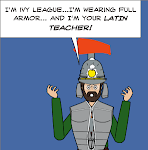
Riley and Ripple-The Roman Pillar Monster-Part 3
This is the exciting third installment in the series that's gaining more and more popularity on Pixton! (at least I hope it's gaining popularity...)
5 Heroes!
Hercules-The most popular of Greek heroes, Hercules was the essence of strength and manliness. Hercules was celebrated in stories, sculptures, paintings, and even the geography of the ancient world. This hero's life was non-stop action, from start to finish. 
Beowulf-Beowulf is from the most important work of Old English literature. Beowulf is a Scandinavian prince who rids the Danes of the monster Grendel (half man, half fiend) and Grendel's mother. Fifty years later he is a king of his native land and fights the dragon who is against his people. 
Knights Templar-The Knights Templar was a military religious order. It was also one of the three major orders of medieval Christian knights. This order was established after the First Crusade. The French gradn master Jacques de Molay confessed under torture, and the knights were all eventually burned at the stake.
Gilgamesh-Gilgamesh was a tyrannical Babylonian king who ruled the city of Uruk. His people disliked him and prayed to the gods about it. Enkidu was sent, and the two wrestled. There was no clear victor, so they became friends. He, advised by an elder, found the plant of eternal youth, but lost it to a serpent and later died. 
Jesus-Jesus was born of the Virgin Mary, and is the Son of God. He taught of God's love. Jesus was crucified for our sins, and rose from the grave. He now lives in heaven with God.
Subscribe to:
Posts (Atom)