Website of the Gods!!!

This is a blog of the gods, Ancient Rome, the Gallic Wars, translations, and other Latiny stuff!

Tuesday, December 15, 2009

Hippocampi-What


The hippocampus is the mythological creature shared by Greek and Phoenician mythology, though the name is purely Greek, meaning "horse" and "monster." It is often called a sea-horse in English. Typically the horse is the front part and a coiling, scaly, fish-like tail. The hippocampus became a part of Etruscan mythology, which affects Roman mythology. Neptune often drives a sea-chariot pulled by hippocampi.
Link: http://www.theoi.com/image/P12.4BThetis.jpg

Monday, December 14, 2009

SPQR-Who


SPQR is an initialism for the Latin phrase "the Senate and People of Rome." It refers to the government of the ancient Roman Republic. It was used as the official signature of the government. It appears on coins, documents made public by inscription in stone or metal, in dedications of monuments and public works, and was emblazoned on the standards of the Roman Legions. The phrase also appears many times in Roman literature.

Link: http://www.novaroma.org/vici/images/thumb/400px-Spqr-big-trans.gif

Friday, December 11, 2009

Titans-What

 The Titans were: Kronos, Koios, Krios, Hyperion, Iapetos, Okeanos, Ouranos, and Gaia. They ruled the cosmos before the Olympians came to power. Hyperion, Koios, Krios, and Iapetos were all posted at the 4 corners of the world, and the Cyclopes and Hekatonkheires were placed in the pit of Tartaros.
A prophecy was told that Kronos' children would overthrow him. Therefore, he ate all of his children as soon as they were born. When Zeus was born, Rhea gave to Kronos, the Titan-king, a rock to eat instead. When Zeus grew up he made Kronos disgorge his siblings, who, being immortal, were still alive. The gods then overthrew the Titans.

Pictures: http://www.fashion-res.com/EX/10-08-03/The%2520Battle%2520Betwee
n%2520the%2520Gods%2520a
nd%2520the%2520Titans.jpg
-http://www.theoi.com/Titan/
Titanes.html

Thursday, December 10, 2009

Latin (FAIL) Review for Mid-term *cough fail cough*

A.
 ID and translate each Ablative Absolute and Passive Periphrastic-> Sententiae Antiquae-> page159
1. Carthago delenda est-Passive Periphrastic
2. Asia victa-Ablative Absolute
3. Omnibus ferro militis perterritis-Ablative Absolute
4. Quidquid dicendum est-Ablative Absolute
5. Sananda sunt-Passive Periphrastic
6. Augusto terras tenente-Ablative Absolute
7. Tarquinio expulso-Ablative Absolute
8. Regenda sunt-Passive Periphrastic

B. 
 ID and Parse each participle-> Sententiae Antiquae-> page 152-> ex. laudans-present active participle
1. Oppressus- future passive participle
2. Tendentes-present passive participle
3. Sitiens-present active participle
4. Fugientia-present active participle
5. Futurarum-future active participle
6. Capta-perfect passive participle
7. Fugienti-present active participle
8. Educandum-future passive participle
9. Scripturus-future active participle
10. Dicturi-future active participle
11. Audituros-future active participle
12. Legens-present active participle
13. Factorum-future active participle
14. Timens-present active participle
15. Iussus-perfect passive participle

16. Emissum-perfect passive participle

C.
 ID the verbs that introduce the indirect statements-> Sententiae Antiquae-> pages 167-168
1. Negavit
2. Pronuntiatis, scivisti
3. Sentis
4. Vidi
5. Cerno
6. Credo
7. Sciebam
8. Nuntiavit
9. Dico
10. Vidisse
11. Putabat
12. Negant
13. Negavi
14. Credo
15. Dicere
16. Aiunt

D.
 ID and translate jussives-> Sententiae Antiquae-> page 191
1. Ducat-let it command
2. Cedant-let them concede
5. Rapiamus-

Wednesday, December 9, 2009

Temple of Peace-Where


The Temple of Peace (AKA Forum of Peace) was built by Vespasian. It was built with the spoils of the Jewish War after the fall of Jerusalem in 71 AD. The temple was dedicated in 75 AD, and it was one of the most impressive monuments in the city. It was located north of the Basilica Aemilia that was in an area of the city that hadn't recovered from the great fire of 64 AD. The forum included a plaza with garden, a temple, and a library, within which were placed many of the treasures from Jerusalem. Vespasian brought multitudes of important works of art from all of Rome to the temple. He made the collection available for the enjoyment of the public.

Picture: http://intranet.arc.miami.edu/rjohn/images/RomeFora/Vespacian%20with%20Temple%20of%20Peace.jpg

Tuesday, December 8, 2009

79 AD-When


Mount Vesuvius erupted in 79 AD. The long, catastrophic eruption lasted 2 days. Pompeii was buried under 60 ft of ash and pumice. Herculaneum, its sister city, was also destroyed and completely buried. Pompeii was lost for almost 1,700 years, until is was accidentally discovered in 1748. Pompeii is now a ruined and partially buried town-city near Naples, in Campania, in the comune of Pompei (sic). It now provides insight into the life of a city at the height of the Roman Empire.

Picture: http://www.dogsofpompeii.com/images/pompeii_temple_of_jupiter.jpg

Monday, December 7, 2009

Ambigrams-What


An ambigram is a typographical design that may be read as one or more words not only in the form presented, but from a different viewpoint, direction, or orientation.The words could be the same or different from the original words. All of the above ambigrams are rotational ambigrams, meaning if you turn them 180 degrees, you see the same word again. "Ambire" in Latin means "to go round, visit in rotation, inspect, circle"

For an ambigram generator, check out: http://www.flipscript.com/ambigram-generator.aspx

Sunday, December 6, 2009

Why Did Pygmies Fight Cranes?


Pygmies were an African tribe who  lived on the southern shores of the great, earth encircling river. They were engaged in eternal war with flocks of migrating cranes. Pygmies were short, dark-skinned men who grew to be the foot of one pygmy. Pygmy was a unit of measure from the length of a man's elbow to knuckle bone (about 1 and 1//2 ft). The pygmies lived in India and sub-Saharan Africa

Picture: http://www.theoi.com/Phylos/Pygmaioi.html

Thursday, December 3, 2009

Domus Augustana-Where


The Domus Augustana was the principal residence of the emperors in Rome from the late 1st to 3rd centuries AD. It covered an enormous area on the southeastern side of the Palatine. This structure dates to the time of Domitian (AD 51-96). It was designed by his architect, Rabirius. The Domus Augustana sits on massive terraces where the House of Griffins and Nero's Domus Transitoria were buried. The upper level was for public places (ex. reception, banquet halls).  The lower level was for the private quarters of the imperial family. It was located inside of the Circus Maximus, the Hippodrome, and the Septizodium.

Picture: http://maquettes-historiques.net/R93.jpg

Wednesday, December 2, 2009

Definition of a Hero


A hero is one who makes a positive difference in someone else's life. This could be in the form of the garden variety superheroes like Superman, Spiderman, Wonder Woman, etc. It could also be one of the great heroes of Greek mythology, like Perseus, Heracles, and Achilles who are eventually deified. Then there are the less known heroes, the person who saves a child from a life of crime and redirects him towards good, or the person in the bank during the robbery who takes down the robber before he strikes, or all the policemen/policewomen and firefighters from 9/11, or the soldiers in Iraq who gave their lives for their country. A hero is one who is selfless for the good of others. Heroes may not always succeed. Maybe the man trying to stop the robber gets shot, but that doesn't make him any less of a hero. The thought and act of self-sacrifice, courage, altruism, and moral good were there.
Heroes are not the ones who score the game-winning touchdown or make the last goal in their soccer game to win it, they are the ordinary people who do extraordinary things. Heroes don't necessarily have to be the big, courageous, strong types either. The person who donates his time and efforts to Manna House, for example, is a hero of his own.
Heros are also not those who do the act of heroism just for the credit. They are those who never want the credit.
A hero is one who does great deeds for the benefit of others. A hero makes a difference.

Picture: http://sojournproject.files.wordpress.com/2009/06/super_hero.jpg

Tuesday, December 1, 2009

Satyrs-What


In Greek mythology, satyrs are deities of woods and mountains. They are half man, half goat. The upper half of the body is human, while the lower half has a goat's tail, flanks, and hooves. Even though the upper part of the body is human, they also have the horns of a goat. Many satyrs are the companions of Dionysus, god of wine. They spend their time drinking, dancing, and chasing nymphs.

Picture:http://www.elfwood.com/art/s/a/sarabean/satyrs.jpg

Monday, November 30, 2009

Chapter 28 Optional (yet not so optional) Exercises

  1. Other than fact, but could become fact
  2. More common
  3. -e, -a
  4. Jussive
  5. Purpose
  6. Jussive
  7. No
  8. Subjunctive labels
    1. He will send
    2. Subjunctive-3rd sing
    3. He is sending
    4. Subjunctive-3rd sing
    5. He gives
    6. Subjunctive-3rd plural
    7. They believe
    8. They will believe
    9. They move
    10. Subjunctive-3rd plural
    11. We shall be heard
    12. Subjunctive-1st plural
    13. We are heard
    14. Subjunctive-2nd sing
    15. You are seizing
    16. You will seize
    17. They are known
    18. They shall be known
    19. Subjunctive-3rd plural
    20. You are freed
    21. Subjunctive-2nd plural
    22. You will be freed
    23. They are destroyed
    24. Subjunctive-3rd plural
    25. You will be conquered
    26. You are conquered
    27. Subjunctive-2nd sing
    28. We say
    29. We shall say
    30. Subjunctive-1st plural
  9. Let the leader come. We are waiting for him.
  10. Let the lowly citizens depart from our state so that we may live in leisure.

Themis-Who


Themis was the Greek Titan goddess of divine law and order (the traditional rules of conduct first established by the gods). She was also a prophetic goddess who presided over Delphoi. Themis was the divine voice (themistes). She first instructed mankind in the primal laws of justice and morality. Themis was an early bride of Zeus, and is often represented seated next to him, advising him.

Picture:http://www.theoi.com/image/T8.1Themis.jpg

Chapter 28 SA

  1. Let reason lead, not luck.
  2. Let arms yield to the toga.
  3. Leave the city so that I might not be suppressed by fear and weapons.
  4. One thin must be done immediately in order to have the greatest peace and solace.
  5. Let us take the opportunity from the day, my friends.

Friday, November 27, 2009

Why did Talos Patrol the Island?


Talos was a giant, living bronze automaton. He was forged by Hephaestus, and Zeus presented him to his lover Europa to protect her. Zeus then sent Europa to the island to Crete, where Talos patrolled the shores for pirates, etc. 3 times a day. If anyone tried landing, he would pelt them with rocks or put them in a a fiery death embrace. Talos was eventually killed with magic from Medea.

Picture: http://goremasterfx.files.wordpress.com/2009/08/talos.jpg

Thursday, November 26, 2009

The Temple of Heliogabulus-Where


The Temple of Heliogabulus was dedicated to the Syrian sun god Heliogabulus. It was built near the imperial palace on the Palatine. It was built by the emperor Elagabulus. Elagabulus moved sacred objects from Roman temples to here. After Elagabulus' assassination, Alexander Severus rededicated the temple to Jupiter Ultor (Jupiter "the Avenger")

Picture: http://www.psy.ritsumei.ac.jp/~akitaoka/sun.jpg

Wednesday, November 25, 2009

First Samnite War (343-341 BC)-When


This war was fought between the Roman Republic and Samnium. The First Samnite War was short, and was marked by Roman victories. This ended after 2 years with the Romans winning over the Samnites. The war with these hill people was ended in a hasty peace, as the Romans were also dealing with other tribes trying to fight Rome.

Picture: http://www.heritage-history.com/books/church/rome/front2.gif

Tuesday, November 24, 2009

Manticore-What


The Manticore was a man-eating Persian monster. It had the body of a lion, the face of a man, and a spike-tipped arrow-shooting tail. "Manticore" was derived from the Persian for "man eater".

Picture: http://www.theoi.com/image/pictures-manticore.jpg

Monday, November 23, 2009

Psyche-Who


Psyche was the goddess of the soul. She was the wife of Eros, the god of love. Psyche was once a mortal princess. Her astounding beauty caught the attention of Aphrodite, who wished that she would fall in love with the most hideous of men. However, Eros fell in love with her and took her to his secret place. Psyche was not to look Eros in the face, but she did. He then abandoned her. She searched all over till she found Aphrodite, who made her so many tasks. In the end, Eros and Psyche were reunited and wed in a ceremony attended by the gods.

Picture: http://shalottianshards.files.wordpress.com/2009/02/gerard_francoispascalsimon-cupid_psyche_end.jpg

Friday, November 20, 2009

Why Pasiphae Married a Bull


Pasiphae was the immortal daughter of the sun god Helios. Pasiphae wed King Minos of Crete. As punishment for an offense to the gods from either Pasiphae or Minos, Pasiphae was cursed with the desire for Minos' finest bull. The Queen had Daidalos make a mechanical bull, endowed with mechanical life. Pasiphae conceived and bore a hybrid child, which came to be known as the Minotaur.

Picture: http://www.explorecrete.com/history/images/pasiphae-minos.jpg

Thursday, November 19, 2009

"Q" Quiz

1. qua-where
2. quam-how
3. quando-when
4. quare-therefore
5. quid-who
6. quidem-certainly
7. quin-indeed
8. quin etiam-in fact
9. quo-where
10. quomodo-how
11. quondam-certain
12. quoque-also
13. veritas-truth
14. superbus-arrogant
15. lux-light
16. credere-I believe
17. nescere-to sin
18. sperare-to hope
19. expellere-to expel
20. MMIX

House of Vesta-Where


This structure is at the foot of the Palatine. It is well-preserved. The House of Vesta is adjacent to the Temple of Vesta. It also includes the living quarters of the Vestal Virgins. Most of the building dates to the time of Trajan.

Picture: http://www.mythinglinks.org/Vesta.JPG

Wednesday, November 18, 2009

An Uncle's Love for his Nephew and Adopted Son

This young man is more precious than I myself am. Also, this man is not from me, but is from my brother. The enthusiasms of my brother are soon still further unlike mine. I have urged my life in the city and I have aimed at peace, that which some consider fortunate, I have never had a wife. But he has done these: he led a life not in the forum, but the fields, he received little money, married a chaste wife, and had two sons. From him I adopted the older one for me myself. I reared him from a small boy, I have loved him as my own. In that young man is my enjoyment; it alone is dear to me

Tuesday, November 17, 2009

Chapter 27-S.A.

  1. He draws my new strength: I see better and I approve, but I make so much worse and I do not know why.
  2. Certain songs are good; many are bad.
  3. He is the best. Nothing is better, I have seen nothing more beautiful than this.
  4. I hope you and this man's birthday and most others are about to drive with happiness.
  5. Since planning and reckoning are in old age, our ancestors called the senate our highest council.
  6. More effort and zeal should be put in domestic matters by us even in military matters.
  7. Neither was the danger graver in the republic, nor the laziness greater.
  8. We are wiser than those men, because we know nature is the best leader.
  9. Nature asks very little, but a wise man accommodates himself to nature.
  10. The greatest remedy for anger is delay.
  11. Which spirits he conquers and anger he contains I do not compare, but I say he is like a god.
  12. Dionysus, a tyrant of a most beautiful city, was a man of great temperance in his ways of life, and in all things was diligent and sharp. He too was fierce and unjust. Out of this affair, if we speak the truth, he seemed very wretched.
  13. If I cannot turn the gods, I shall disturb Acheron.

Monday, November 16, 2009

Pandora-Who


Pandora was the first woman, who was formed out of the clay by gods. Prometheus was assigned the task of creating man, but was displeased and stole fire from heaven. Zeus commanded Hephaestus and the other gods to makes her beautiful and cunning. Pandora was then delivered to Epimetheus, Prometheus' foolish brother, and they were married. As a wedding gift, Zeus gave them a box, or pithos (storage jar). They opened the jar, unleashing a swarm of evils spirits on the world. Only hope (elpis)was left in the box. Pandora's daughter Pyrrha was the first-born mortal child.

Picture: http://abooali.files.wordpress.com/2008/12/pandora.jpg

Friday, November 13, 2009

Top Tens!-Annotated Lists

Ancient Celt/Gaul Culture

  1. Grant, Neil. Everyday Life of the Celts Uncovering History. Black Rabbit Books, 2004. Google Books. Google, 2009. Web. 16 Nov. 2009. <http://books.google.com/books?id=YCV41ImfLvMC&dq=Celt+Armor&lr=&source=gbs_navlinks_s>.

This is an incredibly useful source, with much information and colorful pictures on the Celts. It describes the everyday life of the Celts.

*****

  1. Mallory, J. P., and Douglas Q. Adams. Encyclopedia of Indo-European Culture. Taylor & Francis, 1997. Google Books. Google, 2009. Web. 16 Nov. 2009. <http://books.google.com/books?id=tzU3RIV2BWIC&dq=Ancient+Celtic+Culture&lr=&source=gbs_navlinks_s>.

This is a website with background on the Indo-European Culture, which formed into what became the Celts. Some of this background is needed to understand the growth of Gaul and the Celts over the years.

****

  1. Holcomb, Melanie. "Barbarians and Romans". In Heilbrunn Timeline of Art History. New York: The Metropolitan Museum of Art, 2000–. http://www.metmuseum.org/toah/hd/barb/hd_barb.htm (October 2002)

This Met Museum site talks about the relationship between Rome and the Germanic tribes, including the Celts. This gives background for the diplomatic relations between the tribes and Rome.

****

  1. "The Celtic Influence." BBC. BBC, 23 May 2009. Web. 16 Nov. 2009. <http://www.bbc.co.uk/irish/articles/view/720/english/>.

This BBC source describes who the Celts are and how they influence others. It goes specifically into the Celt and Romans.

****

  1. Green, Miranda J. The Celtic World. Routledge, 1996. Google Books. Google, 2009. Web. 16 Nov. 2009. <http://books.google.com/books?hl=en&lr=&id=DeV3EZKzcqUC&oi=fnd&pg=PA21&dq=Celt+War&ots=28PIepWakP&sig=aJLRfMMSTkF9QPQGdUPhV4gLRJQ#v=onepage&q=Celt%20War&f=false>.

This Google Book has details on the Celtic Culture. It also talks about art of the time and its relation to the Celtic Culture.

****

  1. Smith, A. G. Life in Celtic Times. Courier Dover Publications, 1997. Google Books. Google, 2009. Web. 16 Nov. 2009. <http://books.google.com/books?hl=en&lr=&id=GHwtqUcfy-UC&oi=fnd&pg=PA5&dq=Ancient+Celt+Armor&ots=fq6iVWQKsn&sig=C3sWcYhSFMVfvUIl-L8Cs_oBFBI#v=onepage&q=&f=false>.

This source details the life in Celtic times. It includes illustrations, as a picture is worth 1000 words.

****

  1. Mountain, Harry. The Celtic Encyclopedia. Universal-Publishers, 1998. Google Books. Google, 2009. Web. 16 Nov. 2009. <http://books.google.com/books?hl=en&lr=&id=LTbc1GIAwcIC&oi=fnd&pg=PA3&dq=Celt+Armor&ots=_tZ-RH4rPZ&sig=zfvvRS5HbprtbVgI8Q6b2I9aTGs#v=onepage&q=&f=false>.

This is the Celtic Encyclopedia. It includes a very helpful timeline on the Celts.

****

  1. Duffy, Kevin. Who were the Celts? Barnes and Noble, 19990760716080, 9780760716083. Google Books. Google, 2009. Web. 16 Nov. 2009. <http://books.google.com/books?hl=en&lr=&id=_f3YvBLtPTAC&oi=fnd&pg=PR9&dq=Celt+Armor&ots=QKJYTK1qLV&sig=yCOmroUovJF63jqBShjxbDVIhyk#v=onepage&q=&f=false>.

This site answers the question "Who are the Celts?" It includes historic encounters between Rome and the Celts.

****

  1. Markale, Jean. Women of the Celts. Inner Traditions/Bear & Company, 1986. Google Books. Google, 2009. Web. 16 Nov. 2009. <http://books.google.com/books?hl=en&lr=&id=4UVc6up1HJUC&oi=fnd&pg=PA9&dq=Celt+Legends&ots=lPDAhd1MMu&sig=J64o9CL7Cwf52NIeFlIZf_ytH7Y#v=onepage&q=Celt%20Legends&f=falseG>.

This Google Book has to do with Celtic Culture. More, specifically, it speak about the women of the Celts.

***

  1. Harvey, David. Celtic geographies: old culture, new times. Routledge, 2002. Google Books. Google, 2009. Web. 16 Nov. 2009. <http://books.google.com/books?id=uKwLgFCX5RAC&dq=Celtic+Culture&lr=&source=gbs_navlinks_s>.

Describes old ways as well as new, changed ways. This Google Book also explores Celtic geography.

****

Celt and Gaul Weapons and Warfare

  1. "Terret (Rein Guide) [Celtic; Britain] (1988.79)". In Heilbrunn Timeline of Art History. New York: The Metropolitan Museum of Art, 2000–. http://www.metmuseum.org/toah/ho/05/euw/ho_1988.79.htm (October 2006)

The Celts used chariots in warfare. This was legendary, and this piece of art helps to recreate the history.

*****

  1. Caesar, Julius, and Arthur T. Walker. Caesar's Gallic War: Books I-IV. Scott, Foresman and company, 1907. Google Books. Google, 2009. Web. 16 Nov. 2009. <http://books.google.com/books?id=A7pEAAAAIAAJ&source=gbs_navlinks_s>.

This Google Book is on the Gallic Wars. It includes pictures to further tell the story.

****

  1. "Western and Central Europe, 1000 B.C.–1 A.D.". In Heilbrunn Timeline of Art History. New York: The Metropolitan Museum of Art, 2000–. http://www.metmuseum.org/toah/ht/04/euw/ht04euw.htm (October 2000)

This is a timeline of Western and Central Europe and the Celtic Cultures. Is also puts a date on the confrontation with Rome.

****

  1. Chasseriau, Theodore. Scene from the Gallic Wars: The Gaul Littavicus, Betraying the Roman Cause, Flees to Gergovie to Support Vercingétorix. 1838-1840. Metropolitan Museum of Art, Paris. Heilbrunn Timeline of Art History. The Metropolitan Museum of Art, 2009. Web. 16 Nov. 2009. <http://www.metmuseum.org/Works_of_Art/collection_database/european_paintings/scene_from_the_gallic_wars_the_gaul_littavicus_betraying_theodore_chasseriau/objectview.aspx?OID=110003239&collID=11&dd1=11>.

This is a Met Museum scene of the Gallic Wars. It is an oil on canvas painting.

****

  1. "History of the Celts." BBC. BBC, 23 Nov. 1999. Web. 16 Nov. 2009. <http://www.bbc.co.uk/dna/h2g2/A207479>.

This is a timeline of the Celtic Culture, and follows it over a span of 2500 years! This details the violence between the Romans and Celts.

****

  1. Jimenez, Ramon L. Caesar against the Celts. Da Capo, 1996. Google Books. Google, 2009. Web. 16 Nov. 2009. <http://books.google.com/books?id=c9eujq4oiLIC&dq=Celt+Armor&lr=&source=gbs_navlinks_s>.

This source talks of Caesar's attitude against the Celts. It goes into the details of the Gallic Wars.

****

  1. Caesar, Julius, and Arthur T. Walker. Caesar's Gallic War: Books I-IV. Scott, Foresman and company, 1907. Google Books. Google, 2009. Web. 16 Nov. 2009. <http://books.google.com/books?id=A7pEAAAAIAAJ&source=gbs_navlinks_s>.

This is a link on Caesar's Gallic Wars, books 1-4. It includes a preface on Caesar.

****

  1. Versteeg, Russ. Law and Justice in Caesar's Gallic Wars. HeinOnline. 2005. Web. 16 Nov. 2009. <http://heinonline.org/HOL/LandingPage?collection=journals&handle=hein.journals/hoflr33&div=22&id=&page=>.

This source speaks on the laws and justice of Caesar's Gallic Wars. It includes helpful background information.

****

  1. Duffy, Kevin. Who Were Those Celts?: Everything You Ever Wanted to Know About the Celts. Heritage Books19, 1996. Google Books. Google, 2009. Web. 16 Nov. 2009. <http://books.google.com/books?hl=en&lr=&id=WzEM8TjDa6UC&oi=fnd&pg=PR9&dq=Celt+Armor&ots=Wo1eAK1zx8&sig=_XDIAzAo5MuG8MX3buyGE1hFzcs#v=onepage&q=War&f=false>.

This Google Book source talks of the Celts and their relations to other Cultures. It goes into some detail on the wars of the Celts.

***

  1. Ellis, Peter B. The ancient world of the Celts. Barnes and Noble, 1999. Google Books. Google, 2009. Web. 16 Nov. 2009. <http://books.google.com/books?hl=en&lr=&id=L9gMHcZCi1IC&oi=fnd&pg=PA7&dq=Celt+weapons&ots=yPv1eW8IC2&sig=ucsqwjIqmg9aixuyI-96MR0CjWw#v=onepage&q=Celt%20weapons&f=false>.

This link goes a little into the Celtic culture in relation to war. It also includes some pictures.

***

Celt and Gaul Mythology

  1. Squire, Charles. Celtic Myth and Legend. Courier Dover Publications, 2003. Google Books. Google, 2009. Web. 16 Nov. 2009. <http://books.google.com/books?hl=en&lr=&id=6-g5zu5oBg4C&oi=fnd&pg=PA1&dq=Ancient+Celtic+Mythology&ots=e9oVXD41Yi&sig=HRFiC3h_C4cWt6BYnUyO6jlCW7U#v=onepage&q=Ancient%20Celtic%20Mythology&f=false>.

This is a Google Book on Celtic Mythology and Legend. Mythology is an important aspect to understanding culture.

****

  1. Squire, Charles. Celtic Myth and Legend Poetry and Romance. Kessinger, 2006. Google Books. Google, 2009. Web. 16 Nov. 2009. <http://books.google.com/books?hl=en&lr=&id=jeJJiKop6REC&oi=fnd&pg=PA1&dq=Ancient+Celtic+Mythology&ots=atoWDca2Ni&sig=TpTzozWN0kdnIKS7kFFdE4RvzcM#v=onepage&q=Ancient%20Celtic%20Mythology&f=falseGoogle>.

This Google Book deals more directly with Celtic mythology in the British Islands. This is a little more specific, but shows how Celtic Culture has influenced the British Islands.

****

  1. RollestonN, T. W. Myths and Legends of the Celtic Race. Cosimo, Inc., 2009. Google Books. Google, 2009. Web. 16 Nov. 2009. <http://books.google.com/books?hl=en&lr=&id=IutjLHJzHCAC&oi=fnd&pg=PA17&dq=Celt+Legends&ots=BIs1pSZJbo&sig=hn_3elkTDmAjKKSbQ_UQFyzdF0A#v=onepage&q=Celt%20Legends&f=false>.

This Google Book is on Myths and Legends of the Celts. It also speaks a little on the Celts in ancient history.

****

  1. MacCulloch, John A., Jan Machal, and Louis H. Gray. Celtic mythology. Marshall Jones Company, 1918. Google Books. Google, 2009. Web. 16 Nov. 2009. <http://books.google.com/books?hl=en&lr=&id=-pYYAAAAIAAJ&oi=fnd&pg=PA1&dq=Celtic+Legends&ots=ae7visZvGQ&sig=SWkZcIVsDty74FgSKV2m82vhDlc#v=onepage&q=Celtic%20Legends&f=false>.

This is another Google book on the Celtic Myths. This one, though, has illustrations to help fully describe the Celtic Culture.

****

  1. Ellis, Peter B. Celtic myths and legends. Carroll & Graf, 2002. Google Books. Google, 2009. Web. 16 Nov. 2009. <http://books.google.com/books?hl=en&lr=&id=rsPNup_a2owC&oi=fnd&pg=PA1&dq=Celtic+Legends&ots=lOvvNbygZH&sig=wYuXa73GnFfhifyLPBDJaNnCK2c#v=onepage&q=&f=false>.

This is a Google Book document on Celtic myths and legends. It includes an introduction with information on the Indo-European Culture.

****

  1. Green, Miranda J. Animals in Celtic life and myth. Routledge, 1998. Google Books. Google, 2009. Web. 16 Nov. 2009. <http://books.google.com/books?hl=en&lr=&id=hLOXNZoBhsQC&oi=fnd&pg=PR9&dq=Celtic+Mythology&ots=zxzacjJGBz&sig=u0TQPIPMOo8c6INApYQGVPlwbE0#v=onepage&q=Celtic%20Mythology&f=false>.

This source is a Google Book on Celtic Myth. More specifically, it is on animals in Celtic life and myth.

****

  1. Macbain, Alexander. Celtic Mythology and Religion. Kessinger, 2003. Google Books. Google, 2009. Web. 16 Nov. 2009. <http://books.google.com/books?hl=en&lr=&id=DbwJmL1I4h4C&oi=fnd&pg=PR5&dq=Celtic+Mythology&ots=suMfPTJurO&sig=dpbQKEwTXo5FytU6qrnMQwomNnE#v=onepage&q=&f=false>.

This source is on Celtic Mythology. More specifically, it's on mythology in relation to religion.

****

  1. Monaghan, Patricia. The Red-Haired Girl from the Bog: The Landscape of Celtic Myth and Spirit. New World Library, 2004. Google Books. Google, 2009. Web. 16 Nov. 2009. <http://books.google.com/books?hl=en&lr=&id=3jz2yYtGXnAC&oi=fnd&pg=PA167&dq=Celtic+Mythology&ots=FvPXg2t4zE&sig=3B3TvenTsiaPTIIf9H0rQD9bHbs#v=onepage&q=Celtic%20Mythology&f=false>.

This Google Book source talks about the landscape of Celtic Myth. It detail the red haired girl form the bog.

****

  1. Koch, John T. Celtic Culture: a historical encyclopedia. ABC-CLIO, 2006. Google Books. Google, 2009. Web. 16 Nov. 2009. <http://books.google.com/books?id=f899xH_quaMC&printsec=frontcover&dq=Celt+Culture&lr=#v=onepage&q=Celt%20mythology&f=false>.

This Google Book is an Encyclopedia. It goes into some detail on Celtic Mythology.

***

  1. Rolleston, T. W. Celtic Myths and Legends. Courier Dover Publications, 1990. Google Books. Google, 2009. Web. 16 Nov. 2009. <http://books.google.com/books?hl=en&lr=&id=4CUS2j5fw-QC&oi=fnd&pg=PA94&dq=Celt+Legends&ots=rA1R36LKP2&sig=z2gUQDFAWF-sfJEOGCyA2hcA8CY#v=onepage&q=Celt%20Legends&f=false22>.

This is another Google Book on Celtic Myths and Legends. It also details the Irish invasion myths.

***

Thursday, November 12, 2009

Temple of Sol and Luna-Where


This was the ancient temple of the Sun and Moon, and was built on the south side of the seating of the Circus Maximus. A statue of the Sun, most likely driving a chariot, topped this structure. Edgyptian obelisks were later added by Augustus and Constantius II to give honor to the Sun. For Romans, obelisks symbolized sunbeams. August 24th was the temple's festival day.

Picture: http://www.romereborn.virginia.edu/ge/TS-056.html

Wednesday, November 11, 2009

Battle of Panormus-251 BC-When


The Battle of Panormus was during the First Punic War. The Roman army was led by the Lucius Caecilius Metellus against Hasdrubal of the Carthaginians. The battle was won by the Romans, who continued to keep Panormus for the rest of the war. The Romans had retreated behind the wall of Panmormus, but light soldiers were sent to take down the elephants. The elephants were confused and fled. After the elephants left, Rome hit the Carthaginian army on its flank, scattering the army. The Romans did not pursue, but caught all the elephants left, and then sacrificed them in the circus. This defeat was the end of significant Carthaginian land campaigning in Sicily.

Picture:http://llamabutchers.mu.nu/Zama.jpg

Tuesday, November 10, 2009

Nymphs-What


The nymphs were female nature spirits. They were minor nature goddesses that existed throughout the universe. The rank of the nymph was below the gods, but nymphs were able to attend assemblies at Olympus. The nymphs presided over natural phenomena. Nymphs are responsible for the plants and animals of their domain. Because of this, they were associated with prime gods like Hermes, Dionysus, Artemis, Poseidon, and Demeter. An example of a type of nymphs were the Anthousai, the nymphs of flowers.

Picture: http://coromandal.files.wordpress.com/2009/08/waterhouse_hylas_and_the_nymphs3.jpg

Monday, November 9, 2009

Harpies-Who


The Harpies were spirits of sudden, sharp gusts of wind. These were the hounds of Zeus, who were dispatched by him to snatch people and things from the earth. Quick, mysterious disappearances were often attributed to the Harpies. The Harpies were often depicted as winged women, sometimes with ugly faces and the lower bodies of birds. Zeus once sent the Harpies to plague King Phineus of Thrake as punishment for revealing the secrets of the gods. Whenever food was sent before him, the Harpies would take it from him.

Picture: http://www.theoi.com/image/img_harpyiai.jpg

Friday, November 6, 2009

Why Atlas Holds Up the Sky


Atlas was a second-generation Titan. Atlas was the personification of the quality endurance. Atlas, though, made the mistake of leading the Titans in a rebellions against Zeus. Zeus then punished Atlas by condemning him to bear the heavens upon his shoulders. Atlas also had to spin the Earth on its axis. Homer suggests that he was released from this labor and appointed keeper of the pillars of heaven. Because of his labors, Atlas became the constellation Kneeler.

Picture: http://neoshinka.files.wordpress.com/2008/09/hokuto-no-ken_2_the-farnese-atlas400.jpg

Thursday, November 5, 2009

Altar of Hercules-Where


This altar is also known as the Altar of Unconquered Hercules. The altar was located in the Forum Boarium. This was Hercules' earliest cult-center. This altar was made by King Evander after Hercules slayed Cacus, who had stolen Hercules cattle. The festival day was August 12, and in 312 BC, the state took over the altar. Women were not allowed in the cult, dogs were not allowed in the precinct. Remains of the pavement survive in the crypt behind the Church of S. Maria in Cosmedin.

Picture: http://www.shoshone.k12.id.us/greek/images/hercules.jpg

Wednesday, November 4, 2009

The Gallic Wars-58 through 51 BC-When

The Gallic Wars was a series of military campaigns led by Caesar against several of the Gallic tribes. These wars last from 58-51 BC. The most decisive of the battles of the Gallic Wars was the Battle of Alesia in 52 BC. This victory led to the expansion of the Roman Republic over all of Gaul. This victory paved Caesar's way to becoming the sole ruler of the Roman Republic. Caesar made these wars seem like pre-emptive and defensive, but most historians agree that these wars were fought to Caesar to get out of hi debt and jumpstart his political career. Caesar kept hiss account of this war in his book Commentarii de Bello Gallico. Caesar used "divide and conquer" as his way of thinking for the War, and this was successful.


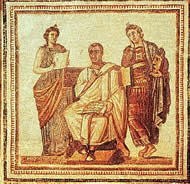
Pictures: http://www.uoregon.edu/~klio/maps/rr/GallicWarmap.gif
http://images.encyclopedia.com/getimage.aspx?id=2795485&hero=yes

Tuesday, November 3, 2009

Reliable Vs. Nonreliable Sources

1. http://www.unrv.com/empire/gallic-sack-of-rome.php-RELIABLE-Story can be authenticated, writer known, sources listed in Bibliography at link: http://www.unrv.com/bibliography.php
This link also speaks about the writer.
2. http://www.ambafrance-uk.org/History-The-Gauls-and-the-Romans.html-RELIABLE-French Embassy Source, with links to the Embassy
3. http://www.megaessays.com/viewpaper/54837.html-NONRELIABLE-Trying to sell stuff.