Website of the Gods!!!

This is a blog of the gods, Ancient Rome, the Gallic Wars, translations, and other Latiny stuff!

Friday, March 20, 2009

Capitoline Hill-Titus' Tour


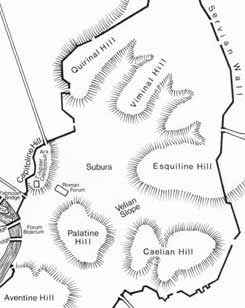
I, Titus Tullius Sextus, finished my porridge and bread, wiped my mouth, strapped on my boots, and adjusted my toga. I stood and looked at the surrounding landscape, which went on as far as the eye could see, past buildings and fields. I sighed. Another long day would be ahead of me. I would first go to the Temple of Veiovis to worship (where I wondered every day why the cella was wider than the front porch), and then I would walk my often-trodden path to the Asylum to give tours of Capitolinus Mons (Capitoline Hill).
This was my job, to appeal to the strangers that entered the Asylum daily, to draw the interest of the travelers from afar. "Titus the Tour Guide" was my title. I would take my customers on a tour of the Asylum and Capitoline Hill, for a fair pay, which provided me with enough for my living.
I am a very knowledgeable guide, or at least I like to think so, but I am getting bored of the same old thing, day after day, rote recitation and routes. I long for something better, something new. I have a feeling this was my lucky day.
I was standing at the main entrance area of the Asylum, watching as the travelers from afar wandered through. I knew by now the right people to pick out. I looked for three things in a potential customer. For one, they could not be weary and tired, for they would never accept to the tour. For two, they should not be walking with purpose, because he could not interrupt their planned travels. For three, they must have enough payment for the tour.
I soon spotted a potential customer who was walking in my direction, or rather, I was spotted by a potential customer who was walking in my direction. This wasn’t normal, but I did my normal spiel of appeal for my tour. The customer was only too anxious, but he also seemed to be nervous. He was quickly looking both ways as if he was making sure he wasn’t followed. I didn’t catch this, so when the shady customer agreed and provided payment, I was only too happy to take this traveler on my first tour of the day.
I always began my tour on the Arx, the northern summit of the hill, which was the higher point of Capitoline Hill. The tour literally only went downhill from there. On the way to the Temple of Juno Moneta I spewed general information about the hill.
“The Capitoline Hill is the smallest of the seven hills of Rome. It is surrounded by steep cliffs on all sides except in the southeast where it is accessible from the Roman Forum. It is located between the Forum and the Campus Martius. It is also the religious center of the city. The northern and southern summits of the hill are divided by the Asylum, which is where we just came from. South of the Asylum are a few other temples, the most prominent of which is the Temple of Jupiter Optimus Maximus. The Capitoline Hill was a site for this temple for the Capitoline Triad, which are Jupiter, Juno, and Minerva. The temple was started under the rule of Rome’s fifth king Tarquin the Elder. Legend says that the recovery of a human skull (“head” in Latin is “caput”) while foundation trenches were being dug led to the name of the hill. When the Senones Gauls raided Rome in 390 BC, this was the one section of the city that evaded capture by the barbarians. Julius Caesar and the brother and nephew of Vespasian also visited this hill. Also-“
“Excuse me”, the shady traveler interjected. “Can you tell me more about the Asylum?”
“I was getting to that”, I answered. “The Asylum is a grove in the depression between the two summits of Capitoline Hill (the Arx and the Capitolium). An asylum can be any place offering safety, shelter, and protection. Tradition states that Romulus invited visitors, settlers, and refugees from afar in the Asylum. This began Rome’s policy of encouraging a diverse population.”
We arrived at the Temple of Juno Moneta. “This is a temple for Juno ‘who warns’. The Roman Mint is located here.” I then showed the stranger the amazing architecture including the marble columns and arches of the temple and then I showed him where the money was made.
When we were both finished, I told the stranger where we would travel next. We were going to the Capitolium to visit the Temple of Jupiter Optimus Maximus, the Temple of Fides, and the Aedes Tensarum. The Aedes Tensarum was first. I answered the traveler’s questions as we walked over. We strolled along as many others were busily hurrying all around. A sweet wind blew, which brightened my mood. I couldn’t get over the fact that the traveler man was jittery the whole time. I tried to wave it off in the back of my mind. When we arrived at the Aedes Tensarum, I began again.
“The Aedes Tensarum is a small temple where symbols of the gods during the theater festivals are stored. Chariots are also housed here.” We then walked to the Temple of Fides, saving the Temple of Jupiter Optimus Maximus for last. On the way to the temple of Fides, I saw a Roman man with a something sharp in his toga and wondered why he looked so mischievous. The traveler then clumsily bumped into him, and we continued on.
At the Temple of Fides I told the man, “This temple is dedicated to the goddess Fides.” I then went on to explain to him that this temple was different in its colorful archaic features. One such requirement was that the priests had to wrap their hands to symbolize the sacred nature of oaths. Senators also met here.
When we arrived at the Temple of Jupiter Optimus Maximus, I felt like I had already told him a lot about it. As I began to tell the man of the highlights of the temple, an actual light appeared near the altar. I walked over to check it out as the light turned into some kind of swirling portal to another area. I turned to wonder aloud to the man, but as I did he drew a knife. He must have pick pocketed it from the man near the Temple of Fides. He stared at me deviously. I looked at him closer and saw the uniform underneath his clothes. “You must have escaped from Carcer”, I said. Carcer was the ancient state prison of Rome at the bottom of the Capitoline Hill. He told me the truth, “Yes, then I stole a uniform from a man at the Temple of Concord. And before you ask, I am killing you to take your place and blend in. I will become you and will never be found.” He glared hungrily at me. On any other day I would have stayed away from the colorful tunnel, but today I spun and dove straight into it.
In the tunnel I wondered why such a portal would open up for me. I came out the other side of the tunnel in a familiar place. It was Capitoline Hill, but it was run down and looked old. I walked outside, confused, and asked the closest person I could see what happened. He told me that the temples were over a thousand years old and that this ruin was bound to happen sometime.
I questioned him again. “What year is this?”
The man answered, “1536.”
My pride for the Hill overtook my confusion of time, place, etc. I told him, “I need to find the nearest architect to fix these buildings.”
He raised his hand slowly and looked down. “I’m an architect”, he said. He looked sad.
“Well great! You can help rebuild and improve these places. I can even help you with them.” He still looked sad. “Come on”, I begged him. “Please, you must help me. This place has a huge historical importance. You must help.”
He finally agreed. “Glad to do business with you”, I said to the man. “My name is Michelangelo”, he said. “And I’m glad to help, too!”
Years passed. The church of Santa Maria de Aracoeli was built at the Arx. The Piazza del Campidoglio and the surrounding palazzos were designed by Michelangelo, who decided to orient the Capitoline towards St. Peter’s Basilica. Still, the Hill was restored, so I was satisfied. Capitoline Museums then opened. I helped bring back the Capitoline. I decided that my purpose of coming into the future must have been to start off Michelangelo. This always confused me. And when I figured out that Rome was gone I almost died, but hey, this was a new start, just like I wanted…
Information Bibliography:
"Capitoline Hill." Wikipedia.org. Wikipedia. http://en.wikipedia.org/wiki/Capitoline_Hill.
"Capitoline Hill." Rome Reborn. Institute for Advanced Technology in the Humanities.
http://www.romereborn.virginia.edu/ge/GF-006.html.
"Asylum." Rome Reborn. Institute for Advanced Technology in the Humanities.

Picture Bibliography:
http://www.ancient-rome.com/images/7hills.jpg
http://www.sacred-destinations.com/italy/rome-capitoline-museum-pictures/eosa_032.jpg
Google Earth Screenshots. Digital image. Google Earth.

Saturday, March 14, 2009

Roman Calendars-A Contribution to Today


The original Roman calendar was chaotic. It included 10 months and 304 days in a year that started with March. Two more months, January and February, were added later that century. Because these months were only 29 or 30 days long, an extra month had to be added about every second year. The days of the month had an awkward method of counting backward from three days: the calends (1st of the month), the ides (the middle of the month, occurring on the 13th sometimes and on the 15th the other times), and the nones (the ninth day before the ides). This was then even more hopelessly confused when officials abused their authority to prolong their terms in office or to hasten or delay elections. In 45 BC, Julius Caesar was advised by the Greek astronomer Sosigenes to use a solar calendar. This calendar became known as the Julian Calendar and fixed the year with 365 days and 366 days every 4th year. This was called a leap year. This order was established as it is known in everyday calendars. In 44 BC Caesar changes the name of the month Quintilis to Julius(July)after himself. Then the month Sextilis was renamed after the Roman Emperor Caesar Augustus (August). The Romans named the days of the week in honor of the sun, moon, and various planets.

Friday, March 13, 2009

Basic Capitoline Hill Story

My name is Titus Tullius Sextus. I work at the Asylum in ancient times. I will be meeting people as they come in, walking around the hill after work, etc.

Latin Phone Numbers!

1410 817 4765-MCDX DCCXVII MMMMDCCLXV
1443 677 3059-MCDXLIII DCLXXVII MMMLIX
1443 564 8456-MCDXLIII DLXIV MMMMMMMMCDLVI
MMMMMMMMMCMXCIX
Football-superbowl
Bottom of sheet music
Clocks
Outlines _
5,000- V _
100, 000- X _
500, 000- D _
1,000,000- M

Tuesday, March 10, 2009

The Gallic War-Julius Caesar

These are the 2nd and 3rd groups of sentences that we were supposed to do.

All these differ from each other in language, customs, and laws. The Garumna River divides the Gauls from the Aquitani, and the Marne and the Seine separate them from the Belgians.

Of all these the Belgae are the strongest, because they are the farthest from the civilization and refinement of our province, and merchants least often resort to them and import those things that tend to effeminate the mind,

Monday, March 9, 2009

Vocab Quiz-Chapter 16

1. aetas-life
2, auditor-listener
3. clementia-mercy
4. mens-mind
5. satura-satire
6. acer-sharp
7. brevis-brief
8. celer-swift
9. dificillis-difficult
10. dulcis-sweet
11. facillis-easy
12. fortis-strong

Saturday, March 7, 2009

Roman Baths-Not quite the same as today...


Public baths (thermae) were all over Rome. They were in large cities and small towns alike. Under the Republic they had hot, warm, and cold-water baths (caldaria, tepidaria, frigidaria). Alongside these baths were the exercise areas (palaestra). The baths near Pompeii's forum (75 BC) are an excellent example of the early type of public baths. Under the empire these structures became grander. Sone examples of these new baths are the Baths of Caracalla (ca. AD 217) in Rome. These also included libraries, lecture halls, and vast vaulted public spaces. They were decorated with statues, mosaics, painting, and stuccos.

Chapter 15 S.A., #'s 1-9

1. I have long been on that ship and because of the storm and the clouds, I kept expecting death.
2. We came up to that city in seven hours.
3. Italy was abundant in the Greek arts at those times, and many Romans cultivated these arts.
4. They kept hesitating between war and peace.
5. In that time, I was driving that man into the city.
6. Each miserable kept saying : "I am a Roman citizen."
7. My girl used to love her sparrow, and the sparrow chirped to her only and it did not move from her lap.
8. My sons used to esteem my brother, they avoided me; they called me a bitter father and awaited my death. Now on the other hand, I changed my morals have changed and I will draw two sons to me tomorrow
9. The tyrant Dionysius, because the head barber kept fearing to commit, he taught his daughters to cut his beard and hair, so the maidens cut their father's hair and beard.

Friday, March 6, 2009

Chapter 15-Numeral Test ='(

Part I-Roman Numerals for 1-23, +50 +90
1. I
2. II
3. III
4. IV
5. V
6. VI
7. VII
8. VIII
9. IX
10. X
11. XI
12. XII
13. XIII
14. XIV
15. XV
16. XVI
17. XVII
18. XVIII
19. XIX
20. XX
21. XXI
22. XXII
23. XXIII
50. L
90. XC

Part II-Cardinals 1-20, + each 10 through 100
1. unus
2. duo
3. tres
4. quattuor
5. quinqua
6. sex
7. septem
8. octo
9. novem
10. decem
11. undecim
12. duodecim
13. tredecim
14. quattuordecim
15. quindecim
16. sedecim
17. septendecim
18. duodeviginti
19. undeviginti
20. viginti
30. triginta
40. quadraginta
50. quinquaginta
60. sexaginta
70. septuaginta
80. octoginta
90. nonaginta
100. centum

Part III-Ordinals 1-20, + each ten through 100
1. primus
2. secundus
3. tertius
4. quartus
5. quintus
6. sextus
7. septimus
8. octavus
9. nonus
10. decimus
11. undecimus
12. duodecimus
13. tertius decimus
14. quartus decimus
15. quintus decimus
16. sextus decimus
17. septimus decimus
18. duodevicesimus
19. undevicesimus
20. vicesimus
30. trigesimus
40. quadragesimus
50. quinquagesimus
60. sexagesimus
70. septuagesimus
80. octogesimus
90. nonagesimus
100. centesimus

Thursday, March 5, 2009

How the Seas Got Their Names

Aegean-name derived from Aegeus, king of Athens and father of Theseus
or from Aegea a queen of the Amazons who drowned in the sea
or from an ancient Greek town known as Aegae
Adriatic-named for Adria, a flourishing port and colony. "Adria" also means "water" or "sea"
Ionian-Io supposedly swam across this sea and it was named after her.
Mediterranean-from "medi" and "terra" in Latin, which make it literally "in the middle of the land"
Tyrrhenian-named for a Greek name for the Etruscans, who were said to be emmigrants from Lydia led by the prince Tyrrhenus.

Wednesday, March 4, 2009

S.A. p. 101 #'s 2 + 8, Cyrus' Dying Words on Immortality

2. We came up to that city in seven hours.
8. My sons used to esteem my brother, they avoided me; they called me a bitter father and awaited my death. Now on the other hand, I changed my morals have changed and I will draw two sons to me tomorrow.

Cyrus' Dying Words on Immortality
Oh my three sons, you ought not be miserable. In fact, now I come to death, but my part, my soul, will always remain. As long as I was with you, you did not see the soul, but from my deeds you realized it was in my body. Therefore, believe that the soul is the same after death, even if you will not see it, and always preserve me in your memory.

Tuesday, March 3, 2009

The Roman Alphabet-A Legacy to Today


One of the descedants of the Greek alphabet was the Etruscan alphabet. The earliest known example of the Roman alphabet was an inscription on a gold brooch in the 6th century. Roman conquests lead to the use of the Latin alphabet as the basic alphabet of all languages of western Europe.
The Romans originally took 21 of the Greek and Etruscan letters as their own. They would represent the sounds of their language. The Greek letters upsilon (Y) and zeta (Z) were originally dropped out of the Latin language. Since the Romans valued the Greek culture highly, they borrowed some Greek words which used "Y" and "Z". Because of this, these letters were eventually added to the alphabet. During the Middle Ages, "J" was a variant of "I" and "U" was a variant of "V". They acheived the status of separate letters during the Renaissance. In northern Europe, when "uu" or "vv" occurred, they eventually became the letter "w". This provided the 26 letters of the Roman alphabet used for modern English.

Europa and the Bull-NOUNS

1. Underline all nouns
2. Identify case of the first 5 nouns
3. Write out the paradigms of those nouns

1. Europam-Accusative
Singular
N. Europa
G. Europae
D. Europae
A. Europam
Ab. Europa
Plural
N. Europae
G. Europarum
D. Europis
A. Europas
Ab. Europis

2. Filiam-Accusative
Singular
N. Filia
G. Filiae
D. Filiae
A. Filiam
Ab. Filia
Plural
N. Filiae
G. Filiarum
D. Filiis
A. Filias
Ab. Filiis

3. Agenoris-Dative
Could be first declension or second declension
Singular
N. Agenor
G. Agenori
D. Agenoro
A. Agenorum
Ab. Agenoro
Plural
N. Agenori
G. Agenororum
D. Agenoris
A. Agenoros
Ab. Agenoris

4. Iuppiter-Nominative
Singular
N. Iuppiter
G. Iuppiteris
D. Iuppiteri
A. Iuppiterem
Ab. Iuppitere
Plural
N. Iuppiteres
G. Iuppiterum
D. Iuppiteribus
A. Iuppiteres
Ab. Iuppiteribus

5. Rex-Nominative
Singular
N. Rex
G. Regis
D. Regi
A. Regem
Ab. Rege
Plural
N. Reges
G. Regum
D. Regibus
A. Reges
Ab. Regibus

Monday, March 2, 2009

Europa and The Bull-Translation and Parsing

Jupiter, the king of the gods, saw Europa, the daughter of Agenor. Overcome by love, he said, "Without this pretty woman I will not be able to live. What am I to do? This maiden, if I will overcome her power, she will not love me, and Juno, my wife, if she will come upon my ambush, she will punish me. Therefore, with skill I ought to lead Europa towards me.

Jupiter, for himself, has dedicated his form to a bull. He has run with speed from his citadel in the heavens through clouds into the land. Europa had wandered with her friends into a remote location. With this she has come to that great bull. She has fled from the boys; only Europa (for she has always loved the animal) she has remained with the bull. She has held her arm to the his own neck; without delay she has drawn this man across the sea.

Europa perceived danger and has called out, "Oh," Jupiter has said, "Beautiful woman, no evil thought is in my spirit. Not bull, but god I am. Not death, but your fame and glory will come, for your great name joins the poet with mine."

Verbs:
1. vidit-3rd person singular perfect indicative active of "videre" meaning "to see"
2. dixit-3rd person singular perfect indicative active of "dicere" meaning "to talk"
3. vivere-infinitive meaning "to live"
4. agam-1st person singular future indicative active of "agere" meaning "to drive"
5. superabo-1st person singular future indicative active of "superare" meaning "to overcome"
6. amabit-3rd person singular future indicative active of "amare" meaning "to love"
7. inveniet-3rd person singular future indicative active of "invenire" meaning "to come upon"
8. castigabit-3rd person singular future indicative active of "castigare" meaning "to punish"
9. ducere-infinitive meaning "to lead"
10. debeo-1st person singular present indicative active of "debere" meaning "ought"
11. dedit-3rd person singular perfect indicative active of "dare" meaning "to give"
12. cucurrit-3rd person singular present indicative active of "cucerre" meaning "to run"
13. erraverat-3rd person singular pluperfect indicative active of "errare" meaning "to wander"
14. venit-3rd person singular present indicative active of "venire" meaning "to come"
15. fugerunt-3rd person plural perfect indicative active of "fugere" meaing " to flee"
16. amaverat-3rd person singular pluperfect indicative active of "amare" meaning "to love"
17. remansit-3rd person singular perfect indicative active of "remansare" meaning "to remain"
18. tenuit-3rd person singular perfect indicative active of "tenere" meaning "to hold"
19. traxit-3rd person singular perfect indicative active of "trahere" meaning "to draw"
20. exclamavit-3rd person singular perfect indicative active of "exclamare" meaning "to exclaim"
21. dixit-3rd person singular perfect indicative active of "dicere" meaning "to talk"
22. sunt-3rd person plural present indicative active of "esse" meaning "to be"
23. sum-1st person singular indicative active of "esse" meaning "to be"
24. venient-3rd person plural future indicative active of "venire" meaning "to come"
25. iungent-3rd person plural future indicative active of "iungere" meaning "to join"

Thursday, February 26, 2009

Take Home Test #2-Chapter 14-Part 2

Read Cicero paragraph. Create 6-9 panel Pixton on it, translating it, illustrating it, and using original Latin.
This might not be the best translation...

Take Home Test #2-Chapter 14-Part 1

Parsing S.A-10 Verbs
1. appellavit-3rd person singular perfect active indicative of "appellare" meaning "to speak to"
2. creavit-3rd person singular perfect active indicative of "creare" meaning "to create"
3. servat-3rd person singular present active indicative of "servare" meaning "to preserve"
4. trahit-3rd person singular perfect active indicative of "trahere" meaning "to draw"
5. teneo-1st person singular present active indicative of "tenere" meaning "to hold"
6. habet-3rd person singular present active indicative of "habere" meaning "to hold"
7. potuit-3rd person singular perfect active indicative of "possum" meaning "to be able to"
8. erat-3rd person singular present active indicative of "sum" meaning "to be"
9. vitabit-3rd person singular future active indicative of "vitare" meaning "to avoid"
10. versate-2nd person plural present imperative active of "versare" meaning "to turn"

Monday, February 23, 2009

Emperor Augustus-Biography


Emperor Augustus was the first emperor of Rome who restored unity and orderly government to Rome after almost a century of civil war. He was ruler over an era of peace, prosperity, and cultural achievement known as the Augustan Age.
Augustus was born Gaius Octavius in Rome on September 23, 63 BC. He succeeded his foster father Julius Caesar as the ruler of the Roman state. Casesar liked him, and raised him to the College of Pontifices (a major Roman priesthood) at age 16. When Caesar was assassinated, Octavius was serving in Illyria. When he returned to Italy, he learned that he was Caesar's adopted heir.
Caesar's death put Rome into chaos. Octavian, who wished to avenge his adoptive father and secure his own place, vied with Mark Antony for power and honor. Octavian was made senator and consul while fighting Mark Antony, both militarily and politically.
Octavian wished to settle the dispute, so they both met with Marcus Aemilius Lepidus, a general. At this meeting, they formed the Second Triumvirate. To seal the deal they proscribed (ordered the death of) 300 senators and 200 knights that were their enemies. Among the killed was Cicero.
Octavian and Antony then went after the plotters against Caesar, who both committed suicide. Octavian controlled most of the western provinces, Antony controlled most of the eastern provinces, and Lepidus controlled Africa. In 36 BC, the last of the enemies of the Second Triumvirate, Sextus Pompeius, was killed. Octavian then forced Lepidus from power while Antony was busy fighting the Parthians. Antony then married Cleopatra, and recognized Caesarion (Cleopatra's son by Caesar) as her coruler. This was against Octavian's position as the only sonof Caesar. War was unavoidable. He defeated Antony and Cleopatra's forces in a naval fight off of Actium in 31 BC. They both killed themselves the next year, and Caesarion was murdered. At 34, Octavian was the sole ruler of the Roman world.
In 27 BC, the Roman Senate gave Octavian the title Augustus ("consecrated" or "holy"). The Senate gave him a lot of other powers and titles that had been other people's jobs in the republic. He was given the inviolability of the plebeian tribune and received the tribunician power (gave him control over veto and the assemblies). He also had ultimate authority in the provinces. He held the consulship 13 times during his reign which gave him control of Rome and Italy. After the death of Lepidus he became the Pontifex Maximus ("chief priest") with control of religion.
All of these powers put together gave him the title of the princeps, or first citizen.
Augustus was a patron of the arts and was a friend of Ovid, Horace, and Vergil. He also was a friend of the historian Livy. He loved architecture and "found Rome brick and left it marble." He also attempted moral legislation.
His heirs died, one after the other, and his son-in-law Tiberius succeeded him when he died at Nola on August 19, AD 14.

Sources:
Microsoft ® Encarta ® 2007. © 1993-2006 Microsoft Corporation.

Julius Caesar-Biography

"Veni, vidi, vici!" This phrase (meaning, "I came, I saw, I conquered") was stated by one of the most famous and powerful rulers of all time after he gained a quick military victory in Asia Minor...This man was Gaius Julius Caesar.

Fun Facts:
-No previous Roman leader had held so many powerful positions simultaneously.
-Caesar was known for more than his military prowess. He was known as a great writer, poet, and scholar.
-He was even the first person to issue coinage with him on it.
-The month July he had named after himself (otherwise, the month would be called "Quintilis")
-He began Rome's transition from republic to empire

Caesar was born in Rome, Italy on July 12 or 13, 100 B.C. He died on March 14, 44 B.C. He was a Roman whose dictatorship would lead Rome to becoming an empire. He laid the foundation for the Roman Imperial system.
Julius Caesar was born to a prestigious family that was famous in politics of the time. During his childhood, Caesar witnessed one of the most horrifying decades in the history of Rome. Political takeovers were causing chaos.
Casesar married the duaghter of his Uncle Marius' associate Cornelia, which allied Marius and his associate. He was ordered to divorce her by Sulla, then fled the city with her to avoid harm. He returned to Rome after the resignation of Sulla, but left again to the island of Rhodes. He returned as a more learned person, prepared to run for office. He had been elected to the ponitificate while he was gone. He formed an alliance with Crassus. Caesar was then elected quaestor (magistrate) in 69 BC. He was appointed aedile four years later. He used money from Crassus to sponsor great events and win support. He also used this money to be elected as the pontifex maximus (high priest) of the Roman religion. When his first wife died, Caesar remarried to the grandaughter of Sulla, Pompeia. He left Rome to be governor of Spain and then married again to Calpurnia.
Upon returning to Rome, he joined hte First Triumvirate with Crassus and Pompey. He was later elected consul and governor of three Roman provinces for 5 years.
He then started a campaign against Gaul, France. He defeated Gaul, but when the tribes there united and revolted he faced some problems with their new leader, Vercingetorix. He eventually defeated him after some major setbacks.
When Crassus died, Pompey wished to get rid of Caesar as well. They had political turmoil. Caesar broke the law and crossed the Rubicon with his army. This led to civil war for four years. Caesar crushed Pompey's forces, but Pompey fled to Egypt, where he was assassinated. Caesar followed to Egypt and won in war against King Ptolemy XIII. He made Cleopatra queen of Egypt.
In 47 BC he went to Asia Minor, and after a victory used the phrase stated above.
Caesar was appointed dictator for life in 45 BC. He was also made consul for ten years in 45 BC. He then renamed the month Quintilis after himself. He called in July.
He was in total command of the armies, which was the backbone of his power. He then made reforms, including reconstituting the courts, increasing the number of senators, and reforming the calendar.
All of Caesar's honors and power made some senatorial families feel threatened. This led them to hatch a plot to kill Caesar. Gaius Cassius and Marcus Junius Brutus helped with the plot. On March 14, 44 BC, he was killed upon entering a meeting in the senate. At the funeral, Mark Antony angered a few people, who burned Caesar's body in the forum.
His nephew Octavius, who he adopted, was made the first emperor of Rome under the name Augustus.

Sources:
Microsoft ® Encarta ® 2007. © 1993-2006 Microsoft Corporation.

Derrick's Vocab Quiz-Chapter 14

1. animal-animal
2. aqua-water
3. ars-art
4. auris-ear
5. civis-citizen
6. ius-justice
7. mare-sea
8. mors-death
9. nubes-cloud
10. Roma-Rome

Sunday, February 22, 2009

Great Roman Achievements


1. Empire-The first great achievement was obviously the Roman's vast empire. It stretched over 3 continents. It also lasted for a long time. 1101 years...and if the Eastern Roman Empire is included in the number, it would be 2078 years!

2. Army-The Roman Legion was perhaps the most powerful army ever. They were capable of defeating armies much larger than themselves with simple weapons. They had shields, spears, and swords, not tanks, airplanes, battleships, nuclear warfare, etc. like today

3. Modern Cities-The Romans were the founding fathers of many great cities today. Examples include London and Cologne.

4. Great Builders-The Romans were revolutionary builders, engineers, architects. They constructed aqueducts, roads, baths, walls, amphitheaters, temples, arches, cities, palaces, etc. Many of these structures still stand and are used today.

5. Latin-As Rome conquered, their language followed. As the empire collapsed, other languages and empires arose from what was left. Latin gave birth to many other languages, and was the official language of business for a long time.

6. The Alphabet-We use much the same alphabet today as the Romans used, with the additions of the letter "W". Roman numerals are also still used today.

7. Law-Roman law was a great institution. It included the Twelve Tables and the Justinian Code. Rome created many of the laws that we take for granted today. The Romans wrote twelve basic principle laws down on brinze, which came to be known as the Twelve Tables. Later, Emperor Justinian refined many of these laws, which were finished in AD 529 and came to be known as the Justinian Code.

Friday, February 20, 2009

Etymology-25 Words

Latin Italian Spanish French English Meaning
1. amicus amico amigo ami friend
2. liber libro libro livre book
3. tempus tempo tiempo temps time
4. manus mano mano main hand
5. bucca bocca boca bouche mouth
6. caballus cavallo caballo cheval horse
7. filius figlio hijo fils son
8. ille il el le the
9. illa la la la the
10. quattuor quattro cuatro quatre four
11. bonus buono bueno bon good
12. bene bene bien bien well
13. facere fare hacer faire make, do
14. dicere dire decir dire say
15. legere leggere leer lire read
16. unus uno uno un one
17. duo due dos deux two
18. tres tre tres trois three
19. quinque cinque cinco cinq five
20. sex sei seis six six
21. septem sette siete sept seven
22. octo otto ocho huit eight
23. novem nove nueve neuf nine
24. decem dieci diez dix ten
25. undecim undici once onze eleven
26. duodecim dodici doce douze twelve
27. centum cento ciento cent one hundred
28. mille mille mil mille one thousand
29. causa cosa cosa chose
30. finis fine fin fin
31. gens gente gente gent
32. continere continere contener contenir
33. mundus mondo mundo monde
34. dura mente duramente duramente durement
35. claramente chiaramente claramente clairement
36. sola mente solamente solamente seulement
37. cetra mente certamente certamente certainement

Tuesday, February 17, 2009

Take-Home Test Chapter 13

Practice and Review
1. The counsels joined neither with you nor with those others.
2. The entire Roman population has let go of its liberty.
3. The bad king has never been able to capture me myself.
4. At that time, you fled to their father and mother through that place
5. The gods create souls and send them into the bodies of men from the sky
6. They themselves have recently conquered him in Asia by themselves.
7. On the way, Cicero saw her doctor, not his own.
8. No one was able to love the bitter duaghter of the consul himself for long.
9. These men joined Cicero with themselves, for they had always loved him.
10. The woman had sent her letter before that time.
11. That man had a good old age, for he had lived well.
12. The mother understood her son well, and the young man thanked her for her patience.
13. Illi autem adulescentes ad Caesarem ipsum heri venerunt.
14. Cicero igitur nomen eius cum suo numquam iunget.
15. Cicero se semper dilexit et tu etiam te diligis
16. Cicero suos laudabat libros et nunclaudo libros meos.
17. Consul Cicero ipse numquam librum eius viderat.

Sententiae Antiquae
1. He himself was hastening to them and sent he horseman ahead of himself.
2. They could do nothing by themselves without him.
3. He recognized his own seal and his own letter from the beginning.
4. Each loves himself, because each is precious to himself by himself.
5. Out of the fault of another, a wise man corrects his own faults.
6. Withdraw into your very self.
7. The very spirit nourishes itself.
8. A laerned man always has riches in himself.

Honor Pledge-Adam Kuester
On my honor, I have neither given nor received unauthorized aid on this graded academic work

Latin Help-Two sentences and Verbs

All of Gaul is divided into 3 parts, one of which the Belgae inhabit, the Aquitani another, those who in their own language are called Celts, in our third Gaul. All these differ from each other in law, customs, and language.

Incolunt-to be at home
Differunt-to carry apart
Dividit-to divide
Sunt-to be
Pertinent-to stretch out
Gerunt- to bear about
Prohibeo-to hold before
Contendunt-to stretch
Vergit-to bend
Capit-to take in hand

Monday, February 16, 2009

Evils of Rome


1. Slavery-the romans had many slaves. Most of the hard work all over the empire was done in forced labor by slaves. Slaves worked farms, cleaned sewers, and were servants in the wealthy houses. They were owned like they were animals. They could be bought, sold, whipped, and punished by their masters.

2. Bloody Events-when the Romans gathered for events like circuses and chariot races, they gathered for the bloody spectacle. They starved animals and pitted them against each other to tear each other apart. They would have these animals fight people, and people fight others to the death.

3. Insane, Cruel Emperors-Rome had many maniac emperors. Remember the phrase, "power corrupts, and absolute power corrupts absolutely." That definitely applies. Brutality was often the order of the day. For some examples, Caligula had his legions collect shells so he could say he conquered the sea. Nero had his mother and wife killed. Septimius Severus had his opponent's dead body laid out in front of him so he could walk over it with a horse.

4. Ordered Suicides-If an emperor wanted to be rid of a particular person, say, a senator, all he had to do was write the senator a letter telling him to kill himself. He could also order someone else to kill that person. Dictator Sulla invented the proscription, by which he would announce who he wanted dead. This would be read in public, and he would reward whoever did the deed.

5. Religious Persecution-Rome kept a brutal enforcement of religion. Several wars were fought with Jews to try to make them worship the Roman gods.

Friday, February 13, 2009

HOSTILE PEOPLES-Trojan War Edition!

HOSTILE PEOPLES
-a warlike people review-

TROJAN WAR PERSPECTIVES

Being a non-baised newspaper, Hostile Peoples like to give the news from all points of view, so people from all over were brought in to be interviewed on the Trojan War. There are Nikolas and Amas, Greek warriors. There is Echemmom, a Trojan warrior. There is Pithana, a Hittite scribe. Finally, there is Koon, a Sea Person. The interviewer is Adamus. The people were interviewed at slightly different times in the war because of travel times between the places.

Nikolas and Amas-Greek Warriors
Adamus: "Hey I'm Adamus, and I'm here to ask you a few questions. First off, why have you chosen to fight this war with the Trojans?"
Nikolas: "I am sent because I am of the city-state that Helen was taken from."
Amas: "I did not get to choose whether or not to fight, I had to. I was of the many people that wished to court Helen, so I was made to swear an oath to protect the rights of her husband should anyone try to take her away. I came from Pylos. I am here to help bring her back, according to my word."
Adamus: "Greece is an area of many divided city-states. How has Agamemnon unified you in spite of this?"
Amas: "That's a hard objective that Agamemnon has accomplished."
Nikolas: "I think he used the common goal and common enemy angle to bring us
together. Such a centripetal force has seemed to work out well so far."
Adamus: "You spoke of centripetal forces. Do you know of any other of these forces that is holding the Greek army together against the Trojans?
Nikolas: "Well, we also have a similar cultural identity. We worhsip the same gods, speak the same language, and more like that."
Amas: "I agree. We are similar even down to liking the same kinds of art. This all helps to keep us unified, though sometimes it is hard."
Adamus: "What areas are the warriors you've come to know from?"
Amas: "Well, my companions are from Mycenae, Pylos, Sparta, and Thebes."
Adamus: "And you, Nikolas?"
Nikolas: "My comrades are from Iolkos, Orchomenos, and various islands."
Amas: "People from Greece are coming from all around for this war."
Adamus: "How long has this war lasted and what is the attitude of the army after so much time?"
Nikolas: "Well, it's been well over nine years. This has been a drawn out war, and we are still at a stalemate."
Amas: "The army is starting to fall apart. We aren't unified as much as before anymore. It's becoming hopeless. Many warriors are thinking of traveling home. The people are tired of the constant war."
Adamus: "So you're saying that you're not as much of a hostile people anymore? *chuckle*"
Nikolas: "Yeah, I guess...why?"
Adamus: "It was a joke...That's the name of the newspaper I'm interviewing you for."
Amas: "What's a newspaper?"
Adamus: "That doesn't matter right now...What has kept the war at such a stalemate for so long?"
Nikolas: "The Trojan's walls. They live inside of a walled city. We can't get past them."
Amas: "I think the plan started out that we should just wipe them out, but then we realized they had the walls, so I think the plan now is for siege."
Adamus: "Do you know of any heroes on your side of the war?"
Amas: "Well there's Achilles, Patroclus, the two Ajaxes..."
Nikolas: "...Teucer, Nestor, Odysseus, and Diomedes."
Adamus: "Okay, cool. Well, it's been a good time interviewing you and I hope to see you again." Nikolas: "It's been a pleasure being interviewed."
Amas: "Bye."
Continued on page A9

Echemmom-Trojan Warrior
Adamus: "Hey I'm Adamus, and I'm here to ask you a few questions. First off, why did this war start between you and the Greeks?"
Echemmom: "Well, Paris, prince of Troy, went and wooed Helen. He took her from the husband she was already married to, Menelaus, and brought her back here. T
hat, obviously, angered the Greeks, as it would anyone else. After we refused to give Helen back, the Greeks gathered up their armies and allies to come here. We have now been fighting for almost ten years."
Adamus: "How has Troy survived the siege?"
Echemmom: "Well, we have underground water supplies and stored food, but they are now depleting."
Adamus: "What's with the walls?"
Echemmom: "Well, they keep the Greeks out (the good part) and they keep us almost trapped in (the bad part)."
Adamus: "Do you have any comments about the layers of walls I have been hearing about?"
Echemmom: "Well, Troy has been around for many years, and as it has evolved and as the city has been destroyed, we have just built on top of the remains. That helps make it such a hill. That is also why remains of older, destroyed walls can be seen today. I have a feeling we will continue to do this, as it is to the benefit of the city."
Adamus: "How would you describe this story to others?"
Echemmom: "It is a tale of love and war."
Adamus: "You seem to know a lot about Troy's history. Can you tell me a little about it?"
Echemmom: "Well, it was founded by Ilus, son of Tros, from whom the name of Troy was derived. Ilus' son was Laomedon, and his son is Priam, who is currently ruler of Troy. Priam's son is Paris, who took Helen. Hector, the commander-in-chief of our army, is Paris' brother."
Adamus: "So, how do you think this war will end?"
Echemmom: "Well, and this may just be pride speaking, but the only thing that could defeat us is nature or the gods. I have a feeling we will win, in the end. Our allies our sending us support, as well, so I have a good feeling about it."
Adamus: "What about the heroes of this war?"
Echemmom: "Well, there's Hector, Paris, Helenus, Deiphobus, Aeneas, Sarpedon and Glaucus, Memnon, and Turnus. I also hear that Achilles had abandoned the Greek forces, so that is good news for our ranks."
Adamus: "Who is your favorite and why?"
Echemmom: "Hector, because recently he has accomplished a lot. He smashed the fortification of the Greek camp, and he also set one of the Greek ships on fire."
Adamus: "Wow, so do you believe Hector will come out of the war alive?"
Echemmom: "As long as Achilles is gone, I believe he will live through and lead us to victory as commander-in-chief of the army."
Adamus: "Okay, so-"
Echemmom: "I must leave for battle now. My duty is to my ruler before some...What was it? Newspaper?"
Adamus: "Yes, it's for...Okay, he just left."
A9
Pithana-Hittite Scribe
Adamus: "Hey I'm Adamus, and I'm here to ask you a few questions. For one, where are you from?"
Pithana: "I'm from Hattusa, the capital of the Hittite Kingdom. Obviously, we are in Asia Minor. And, before you ask, I have no relation to the Pithana whose successor made Nesa into one of the capitals."
Adamus: "I hear that you're a scribe. Is this true?"
Pithana: "Yes, it is."
Adamus: "Well then, I hear you keep a diplomatic archive of the events going on in the area. Can you describe them to me?"
Pithana: "Well, right now I'm finishing my coverage of the events of the Trojan War with the Greeks. We corresponded with the Greeks for information, but are allies to the Trojans. We use cuneiform and clay tablets. The Greeks won the war, and both their empire and our empire seem to be moving toward a Dark Age. Writings of this is my next project. I hear of a people of the sea coming to do battle. It does not look good for us. That is the project after."
Adamus: "There are different accounts of what ended the war. What do yo
u believe?"
Pithana: "Well, the most common story is that an earthquake brought down the walls of Troy. To be honest, I think that earthquake represents something other than nature. I was sure that the Greeks would win the war before such a thing would happen, even though I rooted for the Trojans. I think the earthquake is representative of a Greek action, but they called it an earthquake to praise Poseidon for his help. I think they must have used something like a horse to help. Possibly hiding inside and being taken inside the gates. They could then attack from inside the city and slaughter. This is just a theory."
Adamus: "Interesting theory. Now, what do you think is the cause of the onset of a Dark Age?"
Pithana: "Well, our empire was unstable and overspecialized. Then the famine hit. Now I hear a Sea People is coming to make war with us. There is a mass migration out of the city. There is civil war. Rivaling claims to the throne are made. This all just adds up."
Adamus: "How has your civilization come to this?"
Pithana: "Well, from Labarna to now, decisions have been made incorrectly. We should have focused on keeping a stable civilization more than specializing. That has caused the famine to take such a toll."
Adamus: "So, do you think Troy will ever be forgotten?"
Pithana: "That is something I am trying to prevent. I don't think Troy will ever be forgotten, though. This has been a long war between huge powers of the area. If my records are never found, then someone else's should be. This war was a big deal. The only thing that should ever be debated is the reason that the war ended. This even I am not sure of. I have no more patience to answer questions for this Newspaper person, so I will leave now and get back to work."
Adamus: "Well, thanks for your time, but I need to complete the most difficult part of my search for knowledge. I need to find a Sea Person."
A10
Koon-Sea Person
Adamus: "Hey I'm Adamus, and I journeyed from afar to ask you a few questions. It took some searching, but now I finally can sit down for the last portion of my article. For one, a newspaper is something that has the news all written down in many pages of paper. Every single person I have interviewed so far has had no clue. Just shake your head and pretend you understand..."
Koon: "Okay..." *nod, nod*
Adamus: "Now we can get to the questions. First, where are you all mostly from and why have you caused such a collapse of society in the Hittite Empire?"
Koon: "We are of many people from all over. Most of us are displaced Mycenaea
ns, though. We are invaders of Asia Minor and Syria. We conquer and control. The Hittite Empire fell to us as the Egyptians will."
Adamus: "You seem very confident. How can you be so sure you will defeat Ramses III and his forces?"
Koon: "Well, they are already weak from the war with the Libyans, and we are strong."
Adamus: "You have been called a symptom of the dissolve of the Hittite Empire. Any comments?"
Koon: "Good, intimidation will help us. We invaded the Hittite Empire in a time of their weakness, and overcame easily."
Adamus: "Do you ever regret what you do or consider it as morally wrong?"
Koon: "Well, we are a seafaring, raiding, bandit people. What do you expect?"
Adamus: "Do you spend more time on the sea or on land?"
Koon: "We spend more time on the land, but we attack from the sea whenever we can."
Adamus: "The Egyptians are keeping records of your progress. They call you a foreign people that cut off where you are attacking, and then destroy the places one at a time. Could this have been the reason you are known as Sea Peoples? You surround and make an island, then attack."
Koon: "Well, I don't think so, but possibly."
Adamus: "Well, the Egyptians also say that no land can stand before your arms. Again, any comments?"
Koon: "Well, that is exactly the impression we like to make and that is exactly what we have done so far..."
Adamus: "Rumors say that you are part of the cause of the fall of the Mycenaean city-state. Is this true?"
Koon: "We may have had a hand in it, but why should I tell you?"
Adamus: "I guess, 'for the name of literature', wouldn't be a good answer?"
Koon: "No...You know, we are the reason of the onslaught in the Mediterranean? Why would you dare to come into our camp for some writings on paper? You would risk your life for such a cause?"
Adamus: "My life and my job, sir. I also thought I'd be the one asking the questions..."
Koon: "You'd better run, if you value your life..."
Adamus: "How long have I got?"
Koon: "I'll give you a few minutes before my men come after you...Go!"
Adamus: "Well then, I'd better go..."

And so he did, but he was captured by the Sea Peoples. Their only record said that they captured him while he was still writing down the story. The work has survived because of the Egyptians triumph over the Sea Peoples. They saw to it that the writings were returned safely.
A11

Monday, February 9, 2009

Echo and Handsome Narcissus

Narcissus was a pretty boy. Many girls love him; He loved none out of that. If alone, he loves himself and life, and drives into the forest. For a long time, the nymph Echo has loved Narcissus, but nevertheless he was able to talk to his friends; he is able to give back one other final word. If Narcissus calls, "Are you here?", Echo calls , "Here." If that man "Where are you?"Come!", he calls, that woman "Come!", calls. But Narcissus did not come from himself, and Echo, therefore, did not live for a long time. He wholly lost his body; however we now hear his voice also.

Meanwhile, Narcissus sees his image in a pool of water and is not able to move away his eyes. He was overcome by great love for himself. Time flies; Narcissus remains there. They were not able to come upon his friend. Before himself in the pool of water, where that man exists, now is a pretty flower. This name is perpetual in Narcissus.

Humans ought not love themselves too much.

Sunday, February 1, 2009

Ancient Olympics!


The ancient Olympic Games, one of the four great national festivals of ancient Greece. The other three are the Isthmian Games, the Pythian Games, and the Nemean Games. The Olympics is the most famous of the four. The ancient Olympic Games were held in the summer every four years. They took place in the sanctuary of the god Zeus at Olympia. The history of the games date back to 776 B.C.

Early in the history of the Games, envoys were sent throughout all of Greece. They were sent to the various city-states to gather participants to pay tribute to Zeus. The city-states dispatched groups to fight for the splendor with their athletic feats. The only people allowed to participate were honorable men of Greek descent.

The order if events is not known with certainty, but the first day of the festivak was a day of sacrifices. The second day was occupied by footraces. On the other days boxing, wrestling, and the pancratium (a combination of the two) took place. Horse racing was a popular event, but was confined to the wealthy, who had to use their own horses. After the horse racing was the pentathlon, a series of 5 events (wrestling, discus throwing, javelin hurling, long jumping, and sprinting). The closing event was a race run in armor.

The victors were awarded crowns of wild olive. The victors often lived the rest of their lives at public expense. They were also celebrated by poets.

The height of the ancient Olympic Games was reached in the 5th and 4th centuries B.C. In circa 393 A.D. the Roman Emperor Theodosius I suppressed them. The concept of the Olympic Games was revived in the 18oos.
The graphic is the stadium at Olympia.

Monday, January 26, 2009

Vocab Quiz Chapter 13

1. divitiae-riches
2. factum-deed
3. signum-sign
4. ipse-myself
5. quisque-each one
6. sui-himself
7. doctus-learned
8. fortunatus-fortunate
9. suus-his own
10. nam-for
11. ante-before
12. olim-once
13. alere-to nourish

Tuesday, January 20, 2009

Etruscan Influence on Rome


The Etruscans had a great social, cultural, and political influence on early Rome. This seafaring people brought their language, religion, etc. to northern Italy. Tomb paintings provide insight into the culture of the Etruscans. The skill of the Etruscans at urban planning, engineering, and waterworks all had a deep influence on Rome. Building city walls, engineering the Forum, creating the great drain to the Tiber River, using temple decorations, etc. were all thought to occur becuase of Etruscan influence. Hierarchy and symbols of military authority in Rome were also influenced by the Etruscans. This led to the fasces, a bundle of rods surrounding an axe. The Olympian gods were also in the array of gods of the Etruscans. Since Etruscans cities had disputes, the Etruscans could not unite against a common enemy. This led to fact that the Greek colonies of southern Italy and Sicily defeated the Etruscans in a sea battle. This led to the decline of the Etruscans.
On the map, the Etruscans are in red.

Kings of Rome (Part 2)

Ancus Marcius-fourth king of Rome: Ancus was a highly religious grandson of Numa. He ruled from 640 to 617 BC. He founded the port of Ostia at the mouth of the Tiber River.
Tarquinius Priscus-fifth king of Rome: Tarquinius was a favorite of King Ancus, which led to him being Ancus' successor. He ruled between 616 and 579 BC. He drained the marshes between the hills and helped create the Roman Forum.
Servius Tullius-sixth king of Rome: His rule lasted from 578 to 535 BC. He organized the Roman army into groups of 100 men called centuries. He was said to have built a new wall around the city.
Lucius Tarquinus Superbus(Tarquin the Proud)-seventh king of Rome: He was the cruel seventh king of Rome. He was expelled in 510 BC after his son raped Lucretia. Lucretia was a virtuous Roman matron and the wife of his kinsman Collatinus.

Kings of Rome (Part one)


Romulus-first king of Rome: He founded Rome with Remus in 753 BC, then killed him after he jumped over the wall he made. Romulus invited the Sabines (a people east of the Tiber River) into Rome for a festival. He then kidnapped the Sabine women to provide the wives necessary to make Rome's population grow.
Numa Pompilius-second king of Rome: He was a Sabine who was especially devout to religion. He had a peaceful reign. Many religious traditions of Rome are attributed to him (like having no Romans work on days of festivals of the gods). His reign lasted from 715 to 673 BC.
Tullus Hostilius-third king of Rome: His reign lasted from 672 to 641 BC. Tullus was warlike and started to conquer and expand Rome. When he got the plague the people thought it was a punishment for neglecting the gods. They therefore named Ancus Marcius as the new king

Indo-European Languages

dark green-countries with a majority of speakers of Indo-European languages
light green-countries with an Indo-European minority language with official status

-the most widely spoken family of languages in the world.
-contains the subfamilies Albanian, Armenian, Baltic, Celtic, Germanic, Greek, Indo-Iranian, Italic (includes the Romance languages), Slavic, Anatolian (extinct), and Tocharian (extinct).
-about 1.6 billion people speak Indo-European languages today.
-has a close relationship to Sanskrit and Greek
-originally was highly inflected, but there has been an inflection decay

Thursday, January 15, 2009

Latin 1- Midterm Exam

PART I
Present Indicative Active of sum, esse-to be
sum
es
est
sumus
estis
sunt

imperfect indicative active of sum, esse-to be
eram
eras
erat
eramus
eratis
erant

future indicative active of sum, esse-to be
ero
eris
erit
erimus
eritis
erunt

present indicative active of possum, posse-to be able
possum
potes
potest
possumus
potestis
possunt

imperfect indicative active of possum, posse-to be able
poteram
poteras
poterat
poteramus
poteratis
poterant

future indicative active of possum, posse-to be able
potero
poteris
poterit
poterimus
poteritis
poterunt

present indicative active of laudare-to praise
laudo
laudas
laudat
laudamus
laudatis
laudant

imperfect indicative active of monere-to warn
monebam
monebas
monebat
monebamus
monebatis
monebant

future indicative active of agere-to drive
agam
ages
aget
agemus
agetis
agent

perfect indicative active of agere-to drive
egi
egisti
egit
egimus
egistis
egerunt

perfect indicative active of audire-to hear
audivi
audivisti
audivit
audivimus
audivistis
audiverunt

pluperfect indicative active of capere-to take
ceperam
ceperas
ceperat
ceperamus
ceperatis
ceperant

future perfect indicative active of laudare-to praise
laudavero
laudaveris
laudaverit
luadaverimus
laudaveritis
laudaverint

porta,portae-gate
sg.
porta
portae
portae
portam
porta

pl.
portae
portarum
portis
portas
portis

amicus, amici-friend
sg.
amicus
amici
amico
amicum
amico

pl.
amici
amicorum
amicis
amicos
amicis

puer, pueri-boy
sg.
puer
pueri
puero
puerum
puero

pl.
pueri
puerorum
pueris
pueros
pueris

donum, doni-gift
sg.
donum
doni
dono
donum
dono

pl.
dona
donorum
donis
dona
donis

rex, regis-king
sg.
rex
regis
regi
regem
rege

pl.
reges
regum
regibus
reges
regibus

corpus, corporis-body
sg.
corpus
corporis
corpori
corpus
corpore

pl.
corpora
corporum
corporibus
corpora
corporibus

magnus, magna, magnum-
M
sg.
magnus
magni
magno
magnum
magno

pl.
magni
magnorum
magnis
magnos
magnis

F
sg.
magna
magnae
magnae
magnam
magna

pl.
magnae
magnarum
magnis
magnas
magnis

N
sg.
magnum
magni
magno
magnum
magno

pl.
magna
magnorum
magnis
magna
magnis

hic, haec, hoc-this
M F N
hic haec hoc
huius huius huius
huic huic huic
hunc hanc hoc
hoc hac hoc

hi hae haec
horum harum horum
his his his
hos has haec
his his his

ille, illa, illud-that
M F N
ille illa illlud
illuis illluis illuis
illi illi illi
illum illlam illud
illo illa illo

illi illae illa
illorum illarum illorum
illis illis illis
illos illas illa
illis illis illis

adulescens-young man
pater-father
caput-leader
nemo-therefore
capio-to take
dico-to call
fugio-to flee
studium-eagerness
solus-alone
ducere-to drive
scribo-to write
terra-earth
labor-labor
neco-to kill
discipula-learner
noster-our
remaneo-ro remain
otium-peace
sapientia-wisdom
vir-man
hodie-today
antiqua-ancient
pecunia-money
cogito-to think
voco-to talk

PART II
My girl does not love me. Be strong, girl! Catallus is firm: the poet does not love the girl, he does not praise the beauty of the girl, he does not give roses to the girl, and he does not kiss the girl! My anger is great! I am firm, my girl-but I am not strong without you.

"Our army is great", a Persian says, "and because of the number of our arrows you will not see the sky!" Then Lacedaemonius responds: "In shade, therfore, we will fight!" And Leonidas, king of the Lacedonians, shouts: "Fight with spirit, Lacedonians: today perhaps we will dine in the shade!"

Cornelius, man of great wisdom, I ought beautiful new book. Cornelius, my friend, you always praised my books, and are the scholarly schoolmaster of literature! When you have my new labor: The fame of the book (and your fame) is perpetual.

While you declaimed in the great city, my friend, I re-read the war of the Trojan writer in peace.

State war without good cuase you ought not to carry on becuase of anger. If fortunate in fields and life our people are able to defend without war, then we ought to preserve peace: if, however, we are not able to preserve our fatherland and liberty without war, war is necessary. We ought always to demonstrate, nevertheless, great duty in war, and great rejoicing after victory.

PART III
56b Essay

Revolutionary Engineering

The great minds of Roman engineers are what have shaped engineering as we view it today. The Romans were such a successful empire that they had spare time to flourish in sciences, the arts, etc. This time allowed the Romans to think of and employ revolutionary engineering ideas to transform their entire empire. Engineering was very important to the Roman Empire.These great ideas have molded how others engineer to this day. The Romans have invented some of the most widely known engineering feats on the earth.

One good example of the Romans achievement are aqueducts. The aqueducts were pathways for water that flowed downhill and led water from rivers to the cities. Therefore, the Romans could expand farther, wider, and sustain more people in their cities because they had flows of fresh water to the Forum. This had never before been done.
The roads of the Roman Empire stretched far and wide. They connected towns and cities. Roads had never been created before. They were complex pathways with stone and material underneath. They even led water off of them. The only road before this time was the beaten path. This idea had never been conceived or even attempted ever before.
The Romans also improved building structure. They invented arches and pillars. They harnessed marble and other powerful stones. The could then create bigger and more complex buildings.
The Romans had been a founding father of some of the great engineering feats people know and love today. These feats were important to the empire in that they allowed the empire to get "bigger and better". They were why people today think back to the brilliant minds of yore in the Roman Empire. These feats were what helped make the Roman Empire to powerful and respected. Roman Engineering has shaped engineering as we know it today.

Friday, January 9, 2009

Optional (Not really) Exercises Chapter 10

1. 1. 3rd
2. 2nd
3. 4th
4 1st
2. 1. 3rd person, plural, present
2. 2nd person, singular, future
3. 2nd person singular present
4. 1st person plural imperfect
5. 1st person plural present
6. 2nd person singular imperative
7. 2nd person plural future
8. 2nd person plural imperative
9. 2nd person plural present
10. 1st person singular present
11. 3rd person singular present
12. 2nd person imperative singular
13. 2nd person singular imperfect
3. present infinitive, imperative singular, 2nd person singular short stem vowels
4. 1. he, she, it will come
2. he she it comes
3. they come
4. they will come
5. you hear
6. you will hear
7. you hear
8. come
9. you will come
10. come
11. to come
12. he she it makes
13. he, she, it will make
14. we shall make
15. we make
16. they make
17. you make
18. I shall make
19. you will make
20. to make, do, accomplish
5. 1. sentiam
2. sentiemus
3. sentit
4. sentitis
5. sentient
6. sentiunt
7. sentire
8. senti
9. sentiet
10. sentimus
11. iacit
12. iaciet
13. iaciam
14. iacimus
15. iace
16. iacitis
17. iaciemus
18. iacite
19. iacere
20. iacis
6. We were fleeing out of this land.
7. Flee with your duaghter.
8. They will flee into that place.
9. Time flies; hours flee; old age comes.
10. Come with your friends
11. They were coming into your fatherland.
12. Oh great hero, come into our state.
13. You will come upon your son in that state.
14. They were able to come upon little money toward the roads.
15. The tyrant comes upon the way into this state.
16. You take those with friends there.
17. We come up to you with great abundance.
18. He will come upon much fame and glory there?
19. That man was always making war.
20. Those human beings will not make peace.
21. Those make many human beings but these do not make.
22. We do our duty and we shall accomplish.
23. I make great abundance of books.
24. Boys were living with that good man.
25. Into the bookm old men, you will come upon much philosophy and wisdom.

Monday, December 15, 2008

Chapters 1-12 Vocab Test-Cumulative

1. Adulescens-young man
2. Asia-Asia
3. mater-mother
4. pater-father
5. principium-in the beginning
6. pro-before
7. nuper-recently
8. cado-to create
9. caput-head
10. nemo-not any
11. tu-you
12. idem-the same
13. carus-dear
14. neque-and not
15. bene-well
16. intellego-to understand
17. sentio-to feel
18. amicitia-friendship
19. hora-hour
20. senectus-old age
21. veritas-truth
22. voluptas-pleasure
23. quoniam-inasmuch as
24. audire-to hear
25. dicere-to call
26. fugere-to flee
27. invenio-to come upon
28. locus-place
29. studium-eagerness
30. ille-that
31. alius-another
32. neuter-not either
33. solus-alone
34. ullus-other
35. uter-either
36. in-into
37. Cicero-Cicero
38. frater-brother
39. liberitas-liberty
40. scriptor-writer
41. victoria-victory
42. ad-to
43. tamen-nevertheless
44. demonstro-to demonstrate
45. docere-to teach
46. gerrere-to carry on
47. traho-to draw
48. amor-love
49. civitas-citzenship
50. homo-human being
51. littera-letter
52. nomen-name
53. regina-queen
54. tempus-time
55. uxor-wife
56. virtutis-manliness
57. post-after
58. audere-to dare
59. dea-goddess
60. insidiae-plot

Sunday, December 14, 2008

I'm a Curator-Part 2

The sixth picture shows a floor mosiac. This was made around the second half of the 4th century A.D.

The seventh picture shows the Tetrarches. These were made around 305 A.D.
The eighth picture shows an emperor. This was made from 361 to 363 A.D.
The ninth picture shows a Sarcophagus of Volusia. It was made around the early third century A.D.


The last picture shows a Roman glass. This was made around the late third to early fourth century A.D.


I'm a Curator-Part 1

Welcome to the Museum of Old Stuff! I will be giving you a short tour of late Roman Empire art, cause that's what they pay/tell me to do.

The first picture is of Mithras slaying the Sacred Bull. This marble sculpture was originally made around the 3rd century A.D.

The second picture is a bronze hand. This hand bears symbols of the Roman mystery cult of Dionysis.


The third picture shows a sculpture of Emperor Caraclla. It is a portrait bust in military garb.


The fourth picture shows a silver censer. It shows Gospel scenes

The fifth picture shows fragments of a statue of Constantine. This was made anytime from 313-330 A.D.


St. Augustine Post

Augustine was standing at the bow of the trireme, a gift from one of his most dedicated listeners. He had been preaching afar and was returning home with a smile of his face, though his ailment tolled him so. He could taste the salt in the air and it reminded him of the swift winds that blew in Hippo, his homeland. He had finally made it home. He decided he would praise in the temple when he returned to thank God for his surviving his sickness so far. It had been bad enough this time it forced him to return home. Land was spotted.
Within the hour he was on land again and from there he found transport home. The day was long and he had rested a time before he made his way to the temple. On his way he thought he saw dark beings on the horizon, but he disregarded it as a hallucination. As he opened the large double doors of the temple his aching bones creaked. He coughed and pain seared through his inflamed chest. He had decided he would need some time to himself to pray, so he threw a 2 x 4 on the hooks on the door to lock it.
Just as he kneeled to pray someone ran up to him from a passageway in the temple. He must have been in before Augustine locked the doors. He huffed and puffed from his run. He then gathered his wits and spoke. "Father, help, please."
"What is it you need?", inquired Augustine.
"My friend is ill and I believe you can cure him." was the reply
"I'm not sure I can, m' boy. If I could cure people I would have done so to myself by now. "
"I was told in a dream to come to you for help", stated the worried man.
Augustine now knew what to do. He stood up and was led to the worried man's sick friend. "Thank you so much", he said. "By the way, my name is Adam. My friend is Francis."
Along the walk to Francis, both Augustine and Adam thought they might have heard marching and low screams from afar, but they waved it away as little nothings in their ears. They looked at the weapons hanging on the walls and Augustine sighed. He had tried to convince the clergymen to take them down, but they just kept putting them up. When they arrived Augustine laid his hands on Francis, who looked very ill and shaken. He was bright red all over and unconscious. Augustine closed his eyes and recited the Lord's Prayer 7 times. When finished, he raised his hands. The man was looking normal again and woke up.
All were amazed, but there was little time for excitement. There was a large thumping sound from the corridor they had come from.
Augustine quickly started away to figure out the source of the noise and Adam and Francis followed. He took down a broadsword form the wall and casually walked with it to the source of the noise, the front door. He sensed danger. Adam and Francis felt it too and grabbed one-handed axes from the dusty stone walls.
This brought back to Augustine thoughts about his horrible past…
He had been the worst child a mother could know, he had done worse things than one could imagine, he had been completely horrible. He stole, he lied, he cheated, the whole 9 yards…It came to mind because he was fairly experienced with such weaponry because of these deeds.
Thank God for his mother, who prayed for him day and night the whole time…her prayers eventually came true. Augustine saw the light…
He so hoped that his fears were not true. He had heard of the Vandals pillaging and purging the area of everything, burning the cities to the ground and slaughtering all in it. He knew they were somewhat close, but they should not have arrived yet…
He would need to open a door to his terrible past, but he was afraid he would unleash something far worse than any Vandal.
They arrived at the door and it was being beaten in. They readied for the attack.
The door came down in the temple as the companions inside came down upon the Vandals. The Vandals were armed with spears, javelins, and for the elite, long swords.
Francis slashed down the closest Vandal with one swift swing, but did not regain balance in time and was taken by an elite, who took his head clean off.
Adam faired a little better, taking down two before being surrounded. He gave a valiant effort, but one axe against three javelins did no good.
During this time, Augustine had taken down 5 men and was continuing on his onslaught. He decided he was doing this for the temple, and all the religious books it contained.
Augustine stabbed one man arm and told him to leave before he was hurt even more. The man didn't listen and within seconds had a severed arm and a gash across his back. The blood flowed like the Nile. Not just because of what Augustine did to the Vandals, but what the Vandals reeked upon the city.
Augustine was regaining a thirst for such excitement. He searched out the closest elite and challenged him. For every attack of Augustine's, there was a parry by the elite. Longsword to longsword the battle was heated. Augustine faked a thrust to the left and jabbed at the right, finding a mark just below the Vandals heart. He thrust inward the elite fell. He pulled up the other sword and roared.
Augustine was crazed. The blood was as precious as ruby jewelry. He wanted more…more…
He would need some way to justify his actions, though, if he survived. He would tell them he was trying to save the town, that's it. He would look out the Vandal leader to finish it (although he wanted it to never end).
He boldly walked towards the leader, who was marked by armor far better than the rest and weaponry above all the others. The leader was atop a hill, surveying the field and aiding in the battle at the same time.
Augustine wiped the smeared blood of his swords on the ground and wiped the sweat from his face. His weak bones hesitated for a second, and cramped. He wasn't as young as before. He would probably not win this battle, but he would fight with honor.
He walked up to the leader and twirled his swords. The leader gave a gruff laugh and drew two javelins. The leader has distance, but eventually Augustine shattered the two staffs of the javelins. The leader drew a spear and a longsword, and slashed Augustine across his hip and side. Augustine beat the man across the face with the broad of one of his swords and toppled him. He crossed his swords in a X across the neck of the leader and prepared to do off with his head.
Suddenly a pain seared through Augustine above all others. A sword could be seen through his stomach. The acid spilled out from it and scorched his innards. Blood flowed from his wounds and his limp body fell over the incredulous leader.
The Vandals finished their assault and moved on, leaving a battlefield spewed with dark speckled blood and dead bodies.
Augustine's lifeless body laid with white knuckles from his grip of the swords, and he rigor mortised in that position. He was found with foam at his mouth…

Links for info:
"When did the Vandals first exist and what weapons did they use?"Online Posting. 1 Dec. 2008. Yahoo Answers. 14 Dec. 2008. http://answers.yahoo.com/question/index?qid=20081130150746AAe4KyN
O'Donnel, James. "St. Augustine of Hippo." Wikipedia. 14 Dec. 2008. http://en.wikipedia.org/wiki/St._Augustine_of_Hippo